

Two reloading presses sit on opposite ends of the spectrum. One is a compact, affordable entry point. The other is a robust, semi-automated workhorse. The RCBS Partner and the Dillon Precision RL550C represent fundamentally different philosophies in ammunition crafting. This isn’t just about picking a tool; it’s about choosing a reloading path that fits your volume, budget, and goals.
For a new reloader, the choice can be paralyzing. Do you start simple and cheap, or invest in a system built for speed? Honestly speaking, there’s no universal “best” press. The right answer depends entirely on what you plan to load, how much, and your willingness to learn. This side-by-side review cuts through the noise, using only the concrete features of each press to help you decide.
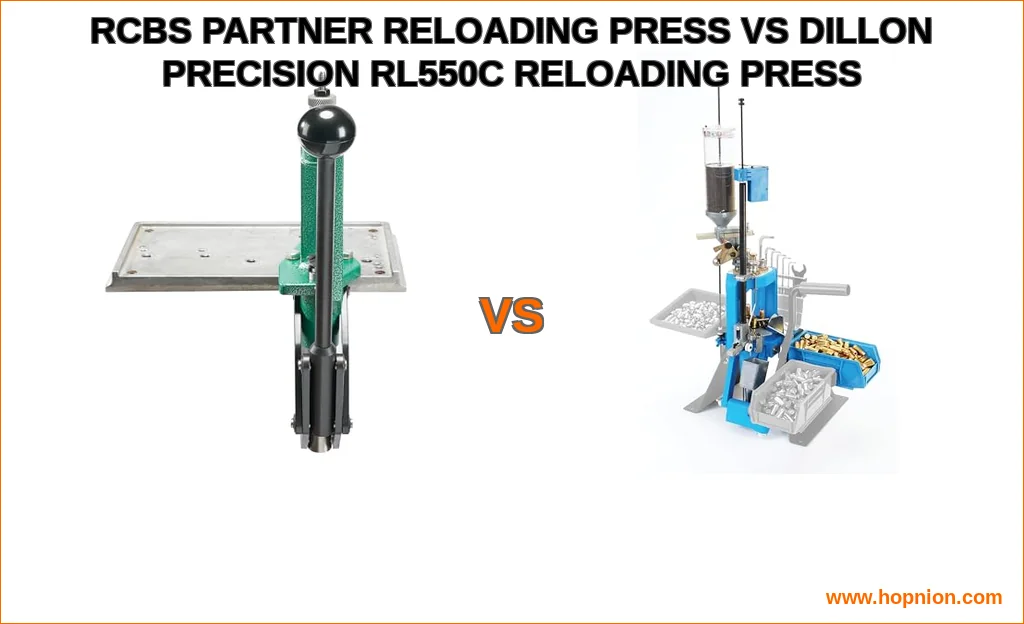
Product Overview: Single-Stage Simplicity vs. Progressive Power
The RCBS Partner Press is a classic single-stage press. Its design is elegantly simple: you perform one reloading operationlike sizing, priming, or seating a bulleton a single case at a time. It’s marketed as “compact” and “lightweight,” built with a “durable aluminum frame” ideal for beginners or those with limited bench space. The focus here is on precision and the fundamentals, offering “reliable performance for precise, low-volume reloading tasks.”
In contrast, the Dillon Precision RL550C is a progressive press. It performs multiple operations with each pull of the handle. A case can be sized, primed, charged with powder, and have a bullet seated in one continuous, manual indexing cycle. Dillon describes it as combining “the repeatability of precision reloading with the speed of a progressive press.” It’s built for throughput, designed to be “fast and easy” while maintaining the quality control that manual indexing affords.
Head-to-Head Feature Comparison
Let’s break down the specifics. This reloading press showdown highlights how their core designs dictate their capabilities.
| Feature | RCBS Partner Press | Dillon Precision RL550C |
|---|---|---|
| Press Type | Single-Stage | Manual-Index Progressive |
| Core Design Philosophy | Compact, lightweight, ideal for beginners/limited space. Focus on precise, low-volume tasks. | Combines precision reloading repeatability with progressive press speed. Built for efficiency. |
| Key Operational Feature | One operation per handle pull. Simple, direct control. | Multiple stations. Features a case-activated powder measure to prevent spills. |
| Caliber Change Process | Requires unscrewing and changing individual dies. | Quick & easy caliber changes via removable toolhead that keeps dies/powder settings intact. |
| Construction & Durability | Durable aluminum frame. Lightweight yet sturdy. | Built for durability & smooth operation. Greaseable lower pivot pin. Made in the USA. |
| Primary Advantage | Simplicity, low cost, small bench mounting footprint, excellent for learning. | Speed, efficiency, and system-based reloading with superior ergonomics for volume. |
| Check current price on Amazon | Check current price on Amazon |
Breaking Down the Differences
The table makes the distinction clear, but the real-world implications are deeper. The RCBS Partner is about mastering one step at a time. There’s a meditative quality to it, and it forces you to focus on each detail. Noise and vibration are minimal due to its simple construction. My honest take is that this forced, deliberate pace is its greatest teaching tool.
The Dillon RL550C is about building a rhythm. The manual indexing means you still control the pace, but your throughput can be 4-5 times higher. The primer system is automated on the downstroke, and the case-activated powder drop is a huge quality-of-life upgrade. However, it demands more initial setup and a sturdier bench due to its size and operating forces. Speaking honestly, the learning curve is steeper, but the payoff in produced rounds per hour is massive.
Price, Value & The Real Cost of Ownership
The sticker price is just the beginning. A true reloading press cost analysis must include what it takes to get started loading your chosen caliber.
The RCBS Partner wins on initial investment. It’s one of the most affordable presses on the market. You’ll need to add dies, a scale, calipers, and a priming tool. Its value is in its simplicity and the legendary warrantyRCBS offers a “limited lifetime warranty.” For the hobbyist loading a few dozen rifle rounds a month, the value proposition is strong.
The Dillon RL550C requires a higher entry fee. More importantly, you must budget for caliber-specific conversion kits. These include the shell plate, locator buttons, and powder funnel. This is a critical missing entity in many discussions. While the press itself is “quick & easy” to change over, each new caliber requires this kit investment. The value, however, is in Dillon’s “unbeatable customer service” and the press’s legendary durability. It’s a buy-once, cry-once piece of equipment for a serious shooter.
So, which is more cost-effective RCBS Partner or Dillon 550C? For ultra-low volume and calibers, the Partner. For anyone shooting more than a few hundred pistol rounds a month, the Dillon’s time savings quickly justify its cost. To be completely honest, your time has value, and the RL550C respects that.
Ideal User & Use Case Scenarios
This is where the reloading press comparison becomes personal. Your shooting habits dictate the right tool.
Who Should Buy the RCBS Partner Press?
- The Absolute Beginner: If you’re asking “is the RCBS Partner good for a beginner reloader?” the answer is a resounding yes. It’s the perfect platform to learn the fundamentals without overwhelm.
- The Low-Volume Rifle Reloader: Someone focused on precision rifle cartridges for hunting or long-range target shooting. Single-stage presses are often preferred for this meticulous work.
- The Space-Constrained Reloader: Its “compact” and “lightweight” design is a genuine benefit for small benches or portable setups.
- The Budget-Conscious Hobbyist: Minimizing initial outlay is the top priority.
Who Should Buy the Dillon Precision RL550C?
- The High-Volume Pistol Shooter: If you’re comparing Dillon RL550C vs RCBS Partner for pistol reloading, the Dillon wins for anyone who burns through 9mm or .45 ACP. The speed difference is not marginal; it’s transformative.
- The Reloader Seeking Efficiency: You understand the process and want to produce quality ammo faster. The manual indexing offers a perfect balance of speed and control.
- The Shooter with Multiple Calibers: The removable toolhead system makes swapping between, say, .223 Remington and .308 Winchester a 60-second task once set up.
- The Investor in a “Forever” Press: You want a press backed by a no-BS warranty that will last a lifetime of reloading.
From my honest perspective, trying to use a single-stage like the Partner for high-volume pistol is an exercise in frustration. Conversely, using a progressive like the RL550C for tiny batches of precision rifle ammo can feel like using a race car to go to the mailbox. Match the tool to the primary task.
Final Verdict & Recommendation
So, which press is better? It’s the wrong question. The right question is: which is better for you?
Choose the RCBS Partner Press if: You are new to reloading, have a tight budget, primarily load low-volume rifle cartridges, or have severe space limitations. Its a superb, no-frills teacher that gets the job done with precision. You can always upgrade later and keep the Partner for dedicated tasks like bullet swaging or decapping.
Choose the Dillon Precision RL550C if: You shoot handgun calibers in volume (or high-volume .223), you value your time and want efficient production, and you’re ready for the investment in a system. Its ergonomics, speed, and support structure are unmatched in its class. Its the press you wont outgrow.
My honest assessment is that this isn’t a direct competition. It’s a choice between a gateway tool and a lifelong system. The Partner is about learning the craft. The RL550C is about mastering production. Both are excellent at what they are designed to do.
Before you buy any press, consult an official source for reloading data and always follow safe practices. For more detailed equipment analysis, including looks at other great brands like Lee Precision, explore our other comparisons. And for a truly unfiltered Honest Opinion on all things gear, you know where to find us.