

Two icons dominate the reloading bench conversation. On one side, the legendary single-stage press known for its unshakable foundation. On the other, a manual-indexing progressive machine built for speed without sacrificing control. The RCBS Rock Chucker Supreme Master Kit and the Dillon Precision RL550C represent two fundamentally different philosophies in ammunition crafting.
This isn’t just about picking a tool; it’s about choosing a workflow that matches your shooting volume, caliber focus, and patience level. From my honest perspective, the right press is the one you’ll use consistently and confidently, whether you’re chasing tiny groups at 1,000 yards or feeding a hungry competition pistol.
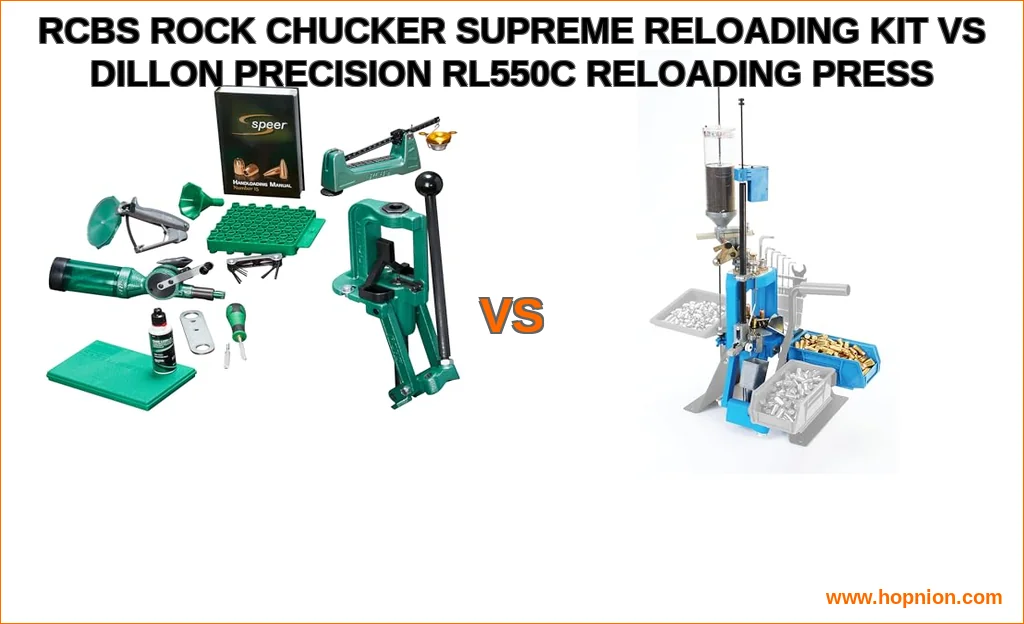
Head-to-Head: Single-Stage vs Progressive Design
At their core, these presses operate on different principles. The RCBS Rock Chucker Supreme is a classic single-stage press. You perform one reloading operationlike sizing, priming, or seatingon a single case at a time. It’s a methodical, focused process. The Dillon RL550C is a progressive press. It performs multiple operations with each pull of the handle, with cases stationed in a rotating shellplate indexing system. The RL550C uses manual indexing, meaning you control the rotation, which honestly speaking, offers a great balance of speed and oversight.
This fundamental difference dictates everything: the pace of your reloading session, the attention each case receives, and the initial setup complexity. A single-stage press like the Rock Chucker is often praised for its simplicity and inherent precision, while a progressive press like the Dillon is built for volume and efficiency.
Detailed Feature Breakdown: RCBS Rock Chucker Supreme Kit
RCBS doesn’t just sell a press; they offer a complete ecosystem to get you started. The Rock Chucker Supreme Master Reloading Kit is famously called “the king of reloading kits” for a reason. It surrounds the legendary Rock Chucker Supreme press with nearly everything you need, except dies and shell holders.
The press itself is the backbone. It features a spacious 4.25″ window, perfect for longer magnum cartridges, and a central pivot design that provides tremendous leverage. This is crucial for resizing tough brass. The kit’s included Uniflow-III Powder Measure is noted for its consistent, accurate charges, while the M500 Mechanical Scale offers +/-0.1-grain accuracy with a magnetic damping system for quick readings.
Speaking honestly, the value here is in the completeness. You get:
- The Rock Chucker Supreme Press
- Uniflow-III Powder Measure
- M500 Mechanical Scale
- Hand Priming Tool
- Universal Case Loading Block
- Case Lube Kit and Debur Tool
- Powder Funnel and Speer Reloading Manual
Its a turn-key solution for someone who wants to learn the craft from the ground up, focusing on rcbs precision and understanding each step intimately. The hand priming tool and mechanical scale encourage a slow, deliberate process that builds foundational skills.
Performance & Ideal Use Cases
This kit excels in low-volume, high-precision scenarios. Think precision rifle reloading for calibers like .308 Winchester or 6.5 Creedmoor, where every charge weight and seating depth is critical. The single-stage operation forces you to inspect each case at every step, minimizing errors. The process is inherently slower, but that’s the trade-off for meticulous control. My honest assessment is that its durability is legendary, built for a lifetime of resizing tough brass with minimal play or flex.
Detailed Feature Breakdown: Dillon Precision RL550C
The Dillon Precision RL550C operates on a different promise: combining the repeatability of precision reloading with the speed of a progressive press. It’s a manual-indexing machine, which means you, the operator, advance the shellplate. This manual control is a significant feature, allowing you to pause and check any station at any time.
Key features that define its workflow include the removable toolhead. This allows for quick caliber changes while keeping your dies and powder settings perfectly intact. Its case-activated powder measure is a clever safety and efficiency feature, dispensing powder only when a case is present to prevent spills.
Dillon emphasizes its durability and smooth operation, highlighting a greaseable lower pivot pin for long-lasting performance. The machine is made in the USA and backed by what many in the community consider unparalleled customer service. From my honest perspective, the RL550C sits in a sweet spotmore accessible than a fully automatic progressive but far faster than a single-stage.
Performance & Ideal Use Cases
Where this press shines is in higher-volume reloading for pistol calibers like 9mm or .45 ACP, or for blasting rifle ammo like .223 Remington. You can easily produce several hundred rounds per hour once you find your rhythm. The manual indexing provides a tactile feel and ensures you’re present for each operation, reducing the chance of a double-charge compared to an auto-indexing press. The primer system is progressive, feeding primers automatically with each stroke, which is a massive time-saver. For a detailed look at how this stacks up against another popular option, consider this precision press comparison.
Performance Analysis: Speed, Precision & Use Cases
Let’s put them side-by-side. The question of reloading speed volume has a clear winner: the Dillon RL550C. A progressive press will outpace a single-stage by a factor of 5x or more. However, raw speed isn’t the only metric.
For reloading precision accuracy, the controlled, step-by-step nature of the Rock Chucker Supreme is often preferred. It allows for weighing every powder charge on the included scale and measuring every case dimension without rushing. The Dillon can achieve excellent precision, especially with its consistent powder measure, but it requires more initial tuning and trust in the system.
Noise and vibration differ too. A single-stage press like the Rock Chucker is generally quieter, with a solid, single “clunk” per operation. A progressive press has more moving partsthe shellplate indexing, the primer feedwhich creates more operational noise. It’s not excessive, but it’s a tangible difference in the reloading room atmosphere.
| Feature | RCBS Rock Chucker Supreme Kit | Dillon Precision RL550C |
|---|---|---|
| Press Type | Single-Stage | Manual-Index Progressive |
| Core Advantage | Precision & Foundational Learning | Speed with Oversight |
| Included Powder System | Uniflow-III Measure & M500 Scale | Case-Activated Powder Measure |
| Priming System | Separate Hand Priming Tool | Integrated Automatic Primer Feed |
| Caliber Change Process | Change shell holder & dies | Swap pre-set toolhead & shellplate |
| Best For | Rifle Calibers, Low Volume, Ultimate Precision | Pistol Calibers, High Volume, Efficient Rifle |
| Check current price on Amazon | Check current price on Amazon |
Addressing Key User Questions
Which is better for precision rifle reloading, RCBS or Dillon?
Honestly speaking, for the shooter who measures every component and chases sub-MOA groups, the Rock Chucker’s single-stage process is harder to beat. It’s the default choice for benchrest and long-range enthusiasts.
Can a beginner start with a Dillon progressive press?
Yes, but with a caveat. A beginner with mechanical aptitude and patience can learn on a Dillon. However, the Rock Chucker Kit teaches the “why” behind each step more thoroughly, building critical habits that prevent costly mistakes on a faster press.
Rock Chucker Supreme kit vs Dillon RL550C for 9mm?
For 9mm, where volume is often the goal, the Dillon RL550C is the overwhelming favorite. The time saved on priming and charging cases is monumental. Loading 9mm on a single-stage can feel like a chore.
Is the Dillon RL550C worth the extra money over RCBS?
This boils down to your time and shooting volume. If you shoot a few hundred rounds a month, maybe not. If you go through a thousand pistol rounds a month, the Dillon pays for itself in saved time very quickly. The initial reloading kit cost is higher, but the long-term time ROI is significant.
Maintenance, Caliber Compatibility & The
Competitors often gloss over the ongoing care these machines need. The Rock Chucker Supreme requires minimal maintenancean occasional wipe-down and a drop of oil on the pivot. The Dillon RL550C, with its more complex shellplate indexing and primer system, needs more regular attention. Dillon recommends periodic greasing of the lower pivot pin and keeping the primer slide and shellplate clean for smooth operation. A little preventative care goes a long way for reloading press durability.
Caliber compatibility is broad for both, but achieved differently. The Rock Chucker uses standard shell holders, giving you access to virtually any cartridge. The Dillon uses specific shellplates and toolheads for each caliber family, which are additional purchases but make changes incredibly fast. For comprehensive technical data, always consult an official source or reloading manual.
Final Verdict & Recommendation: Who Should Buy Which
So, which press wins this reloading press showdown? The truth is, both dofor different people.
Buy the RCBS Rock Chucker Supreme Master Reloading Kit if:
- You are new to reloading and want to build a solid foundation.
- Your primary focus is precision rifle ammunition (bolt-action, long-range).
- You reload in low to moderate volumes and value the meditative, step-by-step process.
- You want a complete kit that needs only dies to start.
- You prioritize ultimate control over each case and operation.
Buy the Dillon Precision RL550C if:
- You shoot high volumes of pistol or semi-automatic rifle cartridges.
- You understand reloading basics and are ready to scale up your output.
- You value efficiency and want to produce quality ammo faster.
- You appreciate the manual-indexing control that prevents “runaway” errors.
- You’re willing to invest more upfront for long-term time savings.
My honest take is that many reloaders end up with both types of presses on their bench. They’ll use the Rock Chucker for developing precision rifle loads and the Dillon for cranking out practice ammo. It’s the classic “quality vs. quantity” setup, and each machine serves its purpose brilliantly.
At the end of the day, the best press is the one that gets you loading safely and consistently. Whether you choose the methodical mastery of the single-stage or the efficient flow of the progressive, you’re investing in the craft. For more unfiltered gear breakdowns like this, the team at Honest Opinion is always digging into the details. Now, get to the bench and make some ammo.