

Two distinct tools from a trusted name in the hobby. The Lee Precision 92139 40th Anniversary Pack and the Lee Precision 90685 Reloading Hand Press represent fundamentally different approaches to the same craft. One is a cornerstone for a permanent single-stage press bench setup, while the other offers ultimate portability. Your choice isn’t just about features; it’s about defining your entire reloading workflow from the ground up.
Honestly speaking, this isn’t a simple case of one being “better” than the other. It’s about matching the right tool to your specific needs, space, and goals. Whether you’re meticulously crafting precision rifle rounds or need a compact solution for the field, core differences is key. Let’s break down what each product actually offers, based on their designs and stated capabilities.
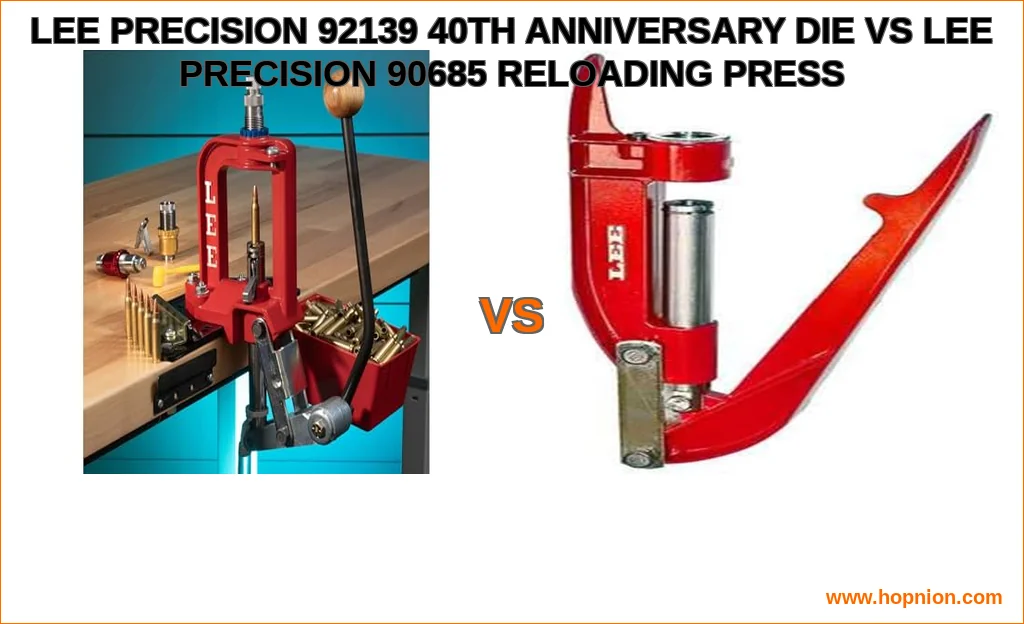
Head-to-Head Product Overview
The Lee Precision 92139 is a comprehensive kit built around a classic, cast-iron single-stage press. Marketed as the 40th Anniversary Limited Edition, it’s designed as a complete starting point. The package includes the press itself, the innovative Breech Lock Quick-Change System, and a dedicated 3-die set for .223 Remington. This is a turnkey solution for someone building their first reloading bench setup.
In contrast, the Lee Precision 90685 strips the concept down to its bare essentials. It’s a hand-held, aluminum-frame reloading press. There are no included dies, no mounting hardware, and no quick-change systems. This is a pure, mechanical tool for the reloader who values mobility above all else or needs a secondary, ultra-compact press for specific tasks. From my honest perspective, comparing them is like comparing a workshop vise to a multi-tool.
| Feature | Lee Precision 92139 40th Anniversary Pack | Lee Precision 90685 Hand Press |
|---|---|---|
| Core Product | Cast-Iron “O” Frame Bench Press Kit | Aluminum Hand-Held Press |
| Frame Material | Cast Iron | Aluminum |
| Primary Use Case | Permanent reloading bench setup | Portable, on-the-go reloading |
| Included Components | Press, Breech Lock System, .223 Die Set | Press only (no dies) |
| Handle Position | Ergonomic lever with priming position | Bottom center |
| Opening Clearance | 4-inch opening for hand clearance | Not specified |
| Check current price on Amazon | Check current price on Amazon |
Key Feature Comparison: Locking System & Dies
The Breech Lock Advantage
The 92139 kit’s standout feature is the integrated Breech Lock Quick-Change System. This system uses threaded bushings that stay in the press. You pre-set your dies in separate bushings, then swap them in and out with a simple twist. The major benefit? You never have to re-adjust your die settings. For reloaders working with multiple calibers, this is a massive time-saver and a boon for consistent reloading precision.
The included .223 Remington 3-die set is a clear signal of the kit’s intent. It’s tailored for a popular rifle cartridge, suggesting a focus on rifle reloading. However, the Breech Lock Quick-Change System means you can easily add bushings and die sets for other calibers, like 9mm, making it versatile. My honest assessment is that this system is a significant quality-of-life upgrade for any serious reloading bench.
The Hand Press Simplicity
The 90685 has no such system. It uses a standard 7/8″-14 threaded press opening. To change dies, you must unscrew one completely and screw in the next, potentially losing your adjustment each time. This makes it less ideal for rapid caliber switching. Its value lies in its singular purpose: to perform a reloading operation anywhere, with minimal setup. You would typically dedicate it to a single die or accept the adjustment process as part of its portable nature.
Speaking honestly, the lack of an included die set with the 90685 is a critical cost consideration. You must factor in the price of at least one die set on top of the press. This changes the value proposition, especially for beginners comparing a full kit against a bare-bones tool. For more on how different die sets pair with presses, our comparison of precision setups is a useful resource.
Performance Analysis: Speed vs. Precision vs. Portability
Build and Leverage
The 92139’s cast-iron “O” frame is noted as the strongest and most popular design. This rigidity is foundational for consistent reloading precision, especially for rifle cartridges that require more force. The compound leverage and ergonomic handle, with its improved priming position, reduce operator fatigue. This allows you to focus on the feel of the operation, which is crucial for detecting issues and ensuring quality.
The 90685’s aluminum frame is lightweight, which is the point, but it inherently offers less mechanical advantage and rigidity than a cast-iron bench press. The force you can apply is limited by your arm strength. I honestly believe this makes it less suitable for full-length resizing of rifle brass or other high-effort operations. It excels at tasks like bullet seating, crimping, or decapping where less force is required.
Workflow and Application
For a dedicated bench, the 92139 is the clear performance leader. The 4-inch opening provides excellent hand and tool clearance. The fixed, stable platform allows for perfect alignment and repeatable strokes. This is the tool you’d choose for reloading precision work, whether you’re answering “which Lee press is better for 9mm reloading” for high-volume pistol or pursuing the “best single stage press for precision rifle” goals.
The 90685’s performance is defined by its context. At a hunting camp, in a small apartment, or as a dedicated depriming station on your bench, it performs brilliantly. Its speed is not in rapid cycling but in rapid deployment. You can store it in a drawer, take it to the range for load testing, or use it while watching TV. Its performance metric is convenience, not raw throughput or ultimate rigidity.
Value Assessment & Target User
Evaluating the “Lee 40th Anniversary kit vs Breech Lock value” requires looking at what you’re actually buying. The 92139 is an investment in a system. You get a robust press, a time-saving quick-change system, and a full die set. For a beginner, this eliminates the guesswork of component compatibility. It’s a complete reloading equipment package that bolts down and becomes the heart of your hobby.
Long-term, the cast-iron construction suggests excellent press durability. The design is also compatible with popular aftermarket upgrades, like sturdy mounting solutions from companies like Inline Fabrication, which can further enhance stability. Considering warranty and support, Lee Precision has a long-standing reputation in the industry, which adds intangible value to their kits.
The 90685 is a tactical purchase. Its value is its low cost of entry and unique portability. It’s perfect for:
- The reloader with zero bench space.
- The experienced reloader wanting a portable tool for specific tasks.
- Someone on an extremely tight budget who already has dies.
- A beginner who wants to literally “get a feel” for the reloading process before committing to a full bench setup.
To be completely honest, asking “is the Lee 92139 worth the extra money” is the wrong question if you need portability. It’s worth every penny for a bench setup. But if your need is mobility, the 90685 is worth its price, as it solves a problem the 92139 cannot. For deeper dives into precision-focused setups, our analysis of another precision kit comparison may offer further insights.
Final Verdict & Recommendation
So, which one should you choose? My honest take is that your decision hinges on a single factor: permanence.
Choose the Lee Precision 92139 40th Anniversary Pack if:
- You have a dedicated space for a reloading bench setup.
- You prioritize reloading precision and consistency above all.
- You plan to reload multiple calibers and value the quick-change system.
- You are a beginner wanting a complete, high-quality starting kit.
- You primarily reload rifle cartridges like .223 or plan to.
Choose the Lee Precision 90685 Hand Press if:
- You have no space for a traditional bench.
- Portability is your primary or only concern.
- You need a secondary, dedicated press for a single task (e.g., decapping).
- Your budget is severely constrained and you already own dies.
- You want a simple tool to introduce you to the mechanics of reloading.
Both are valid pieces of reloading equipment serving different masters. The 92139 is your workshop anchor, built for durability and precision. The 90685 is your field tool, built for flexibility and convenience. For comprehensive information on reloading processes and safety, always consult an official source or authority guide.
In my honest opinion, for 90% of new reloaders looking to build a lasting hobby, the 92139 kit is the wiser long-term investment. It provides a proper foundation that won’t limit you as your skills grow. The 90685 is a brilliant specialist tool, but it shouldn’t be most people’s first and only press. At the end of the day, the best press is the one you’ll use consistently and safely. That’s the Honest Opinion from someone who’s seen both types in action for years.