

Two distinct philosophies of reloading collide on the workbench. The Frankford Arsenal M-Press and the Lee Precision Classic Turret Press represent different paths for shooters looking to craft their own ammunition. One champions a robust, stable platform, while the other delivers a complete, ready-to-run system. Deciding between them isn’t just about specs; it’s about how you want to interact with the process.
This head-to-head look cuts through the noise. We’re focusing on what each press actually offers, from build to bench performance. Whether you’re deep into reloading precision or seeking the best press for beginners, the right choice depends on your goals.
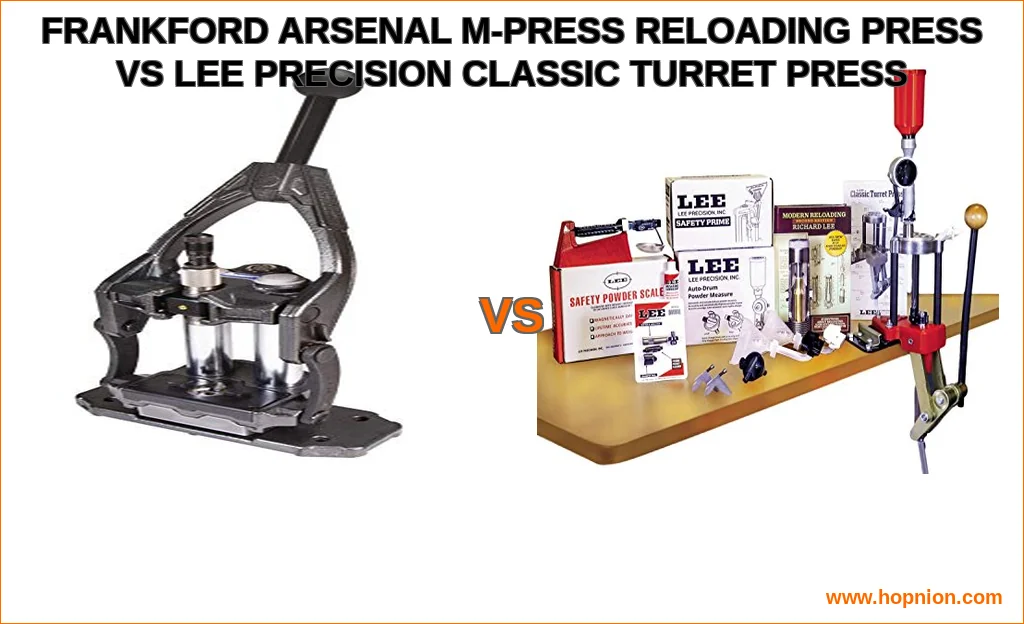
Head-to-Head Comparison: M-Press vs Classic Turret
At their core, these are different machines. The Frankford Arsenal M-Press is a heavy-duty, coaxial single-stage design. The Lee Classic Turret is a versatile system built around an auto-indexing turret. This fundamental difference dictates everything from workflow to final output.
Honestly speaking, the M-Press feels like a fortress. Its 21-pound weight and die-cast construction suggest it’s built to last generations. The Lee, while solid, prioritizes a different kind of efficiency. Its the heart of a kit designed to get you from components to completed rounds with minimal extra purchase.
| Feature | Frankford Arsenal M-Press | Lee Precision Classic Turret Press |
|---|---|---|
| Press Type | Coaxial Single-Stage | Auto-Indexing Turret Press |
| Key Mechanism | Parallel guide rods for stability | Turret head with auto-indexing |
| Included Components | Press, quick-change die blocks, spent primer catcher | Press, Pro Auto-Drum powder measure & riser |
| Construction | Heavy-duty die-cast | Cast iron (Made in USA) |
| Weight | 21 lbs | Not specified in core features |
| Primary Use Case | Ultimate stability for precision operations | Streamlined production of pistol/small rifle cartridges |
| Check current price on Amazon | Check current price on Amazon |
Key Feature Breakdown & Specifications
Frankford Arsenal M-Press: The Stable Foundation
The M-Press is engineered for minimal deflection. Its two parallel guide rods ensure the press frame and ram move in perfect alignment. This coaxial design is a big deal for consistency. The floating shell-holder plate and integrated spent primer system keep the reloading bench clean. It accepts standard 7/8″-14 dies via quick-change blocks, offering flexibility. From my honest perspective, its 20″ L x 9″ W x 6.5″ D footprint demands real estate, but it gives back in rigidity.
Lee Precision Classic Turret: The Integrated System
Lees approach is all-inclusive. The kit includes the Pro Auto-Drum powder measure, which is a significant value adder. The press itself uses a robust cast iron frame and the famous auto-indexing turret. A key note: the bench plate shown in many photos is sold separately. My honest take is that this press is a near-complete starter solution. The inclusion of the powder measure directly addresses a major piece of the case prep and charging workflow, something rarely seen in press kits.
User Experience: Ergonomics, Speed, and Ease of Use
How do these presses feel in daily use? The experience is night and day.
The M-Press excels in deliberate, controlled operations. Its heft and guide rods translate to a smooth, unwavering feel. Youre not fighting the press. This is ideal for tasks requiring supreme reloading precision: sizing rifle brass, seating match-grade bullets, or working through stubborn military primers. The primer catcher is a thoughtful touch for bench cleanliness. However, it is fundamentally a single-stage. Producing a batch of 100 9mm rounds means repeating the same handle pull four times per cartridge.
The Lee Classic Turret, on the other hand, is built for rhythm. The auto-indexing turret automatically rotates to the next station with each stroke. Insert a case, pull the handle four times, and out pops a finished round. For pistol cartridges like 9mm or .45 ACP, the speed difference is monumental. Speaking honestly, the question of Lee Classic Turret Press speed for 9mm is answered by its design: it’s significantly faster than any single-stage. The included drum measure integrates seamlessly, creating a smooth, almost production-line feel.
Noise and vibration are practical concerns. The M-Presss mass absorbs a lot of shock, resulting in a solid, muted operation. The Lee indexing mechanism has a distinct click, but the cast iron frame keeps things steady. Its not obtrusive, just part of its character.
Price Analysis & Value for Money
The value proposition here is clear but different for each press.
The Frankford Arsenal M-Press is a premium single-stage. You’re paying for exceptional build quality, innovative coaxial stability, and that heavy-duty feel. Its an investment in a tool that will perform specific, precision-focused tasks flawlessly for decades. Youll need to add dies, a powder measure, and all other case prep tools separately.
The Lee Classic Turret Press Kit is arguably one of the best values in reloading. As stated, “This kit and a set of Lee dies is everything you need to begin reloading.” Thats a powerful statement. The inclusion of a quality powder measure alone saves $50-$100. For a beginner wondering about Frankford vs Lee reloading press for a beginner, the Lee kit dramatically lowers the initial financial barrier to entry. You buy the press kit, a set of dies, and you’re essentially ready to go.
Warranty, Support, and Parts
This is a critical, often overlooked area. Lee Precision has a legendary reputation for customer service and readily available, affordable replacement parts. Their “Made in USA” tagline comes with a culture of support. Frankford Arsenal, as part of a larger conglomerate, has a more standard warranty structure. While not bad, it lacks the almost folksy, direct accessibility Lee is known for. For long-term ownership, this matters.
Final Verdict: Best Use Cases & Recommendations
So, which press wins? Neither. And both. It entirely depends on your mission profile.
Choose the Frankford Arsenal M-Press if:
- Your primary focus is precision rifle reloading (e.g., .223, .308, 6.5 Creedmoor).
- You value rock-solid stability and minimal flex above all else.
- You prefer a deliberate, step-by-step single-stage mode of operation.
- You already own powder measures and other tools and need a superb press frame.
I honestly believe the M-Press is a specialist. Its the press you use for the most demanding steps where thousandths of an inch matter. Concerns about Frankford Arsenal M-Press durability issues seem misplaced given its construction; it’s built like a tank.
Choose the Lee Precision Classic Turret Press Kit if:
- You are a new reloader looking for the most complete start.
- Your main goal is efficiently reloading high volumes of pistol ammo (9mm, .40, .45).
- The value proposition of an all-in-one kit is your top priority.
- You want the flexibility of a turret that can also be used as a single-stage by simply not indexing.
My honest assessment is that for the majority of handgun shooters and beginners, the Lee kit is the smarter, more practical choice. It solves more problems out of the box. The debate over which is better for pistol reloading Frankford M-Press or Lee Turret leans heavily toward the Lee due to its automated workflow.
For those who demand the utmost in consistency for rifle rounds, the M-Presss coaxial design is compelling. Its a tool that inspires confidence for precision work. Yet, many experienced reloaders end up with both types: a robust single-stage like the M-Press for sizing and depriming, and a turret or progressive for speedy loading. This is the path to true reloading mastery, a topic we explore in our comparison of other tools for precision.
Before you buy, always consult the manufacturer’s official source for load data and safety information. The right press is the one that fits your goals, your bench, and your budget. And from my Honest Opinion, understanding that distinction is the first step to reloading success. For another angle on this crucial choice, see how these brands stack up in a different precision matchup.