

Two distinct philosophies of reloading sit on the bench today. On one side, you have the Frankford Arsenal M-Press, a modern take on the classic single-stage press built for deliberate, powerful operation. On the other, the Lee Precision 90932 represents the accessible, efficient world of the turret press. This isn’t just about tools; it’s about your approach to crafting ammunition. The right choice fundamentally shapes your workflow, your output, and your satisfaction at the reloading bench.
My honest assessment is that both have earned their reputations for good reason. One prioritizes robust simplicity, the other clever speed. We’re going to break down their actual designs, features, and real-world applications to see which press might be the better fit for your bench. This is a classic debate in the reloading community: turret press vs single stage, and the answer is rarely universal.
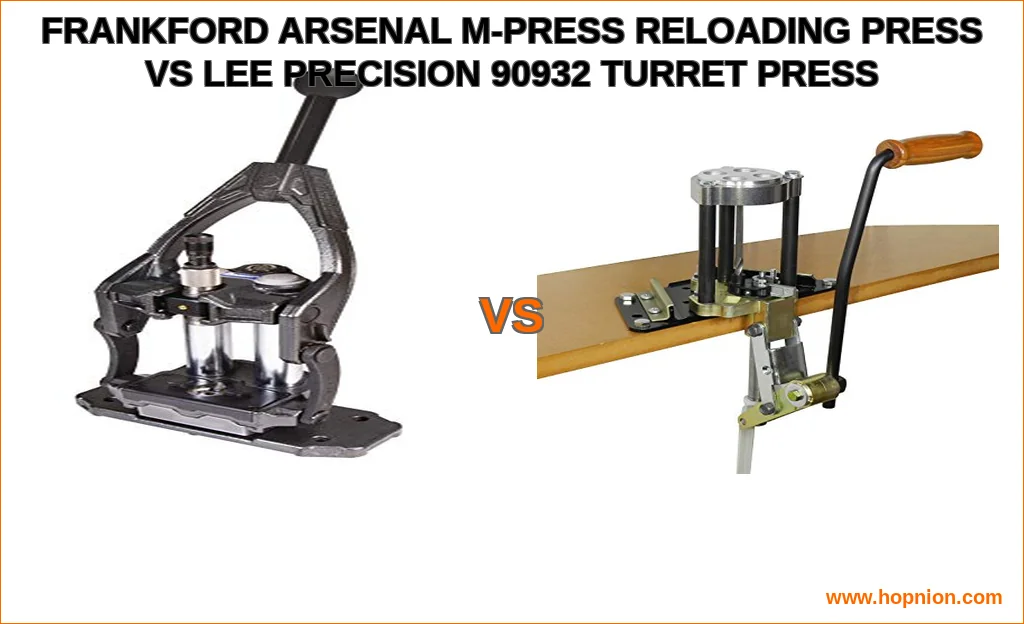
The Contenders: Design Philosophy & Build
At their core, these presses operate on different principles. The Frankford Arsenal M-Press is a coaxial single-stage press. Its design focuses immense force through a direct, vertical ram movement. It features a heavy-duty, die-cast construction weighing 21 lbs, with two parallel guide rods for exceptional stability during the sizing and priming operations. The floating shell-holder plate is a key feature, designed to align cases perfectly with your dies for improved reloading precision.
Conversely, the Lee Precision 90932 is a turret press with a cast aluminum frame. Its defining trait is the auto-indexing turret head that holds four dies. After each pull of the handle, the turret automatically rotates to the next station. This design is engineered for a streamlined process, allowing you to complete multiple operations on a single case without manually changing dies. Honestly speaking, this is the feature that defines its entire value proposition for many reloaders.
Head-to-Head: Core Specifications
| Feature | Frankford Arsenal M-Press | Lee Precision 90932 Classic Turret |
|---|---|---|
| Press Type | Single-stage press (Coaxial) | Turret press (4-Hole, Auto-Index) |
| Frame Construction | Heavy-duty die-cast | Cast Aluminum |
| Weight | 21 lbs | Not specified in provided data |
| Key Mechanism | 2 parallel guide rods, floating shell holder | Auto-indexing turret |
| Die Compatibility | Standard 7/8″-14 dies via quick-change blocks | Standard 7/8″-14 dies in turret |
| Primer Management | Integrated spent primer catcher | Not specified in provided data |
| Check current price on Amazon | Check current price on Amazon |
Feature Breakdown: Operation & Daily Use
How do these presses actually feel? The M-Presss coaxial design and guide rods provide a remarkably smooth, rigid stroke. The included quick-change die blocks are a nice touch, though you’ll still handle one die operation at a time. Its integrated spent primer management system is a clean and thoughtful feature, directing debris away from your workspacea detail often overlooked in press durability and maintenance conversations.
The Lee 90932 is all about rhythm. You set up your die sequence in the turrettypically decap/resize, prime, expand, seat/crimpand the auto-indexing does the rest. This can significantly speed up the process for straight-walled pistol cartridges like 9mm. However, the case priming system on the Lee is a separate, press-mounted unit, which is a different workflow than the M-Press’s potential for on-press priming. I honestly believe the choice here comes down to your tolerance for process interruption versus the desire for a dedicated, high-leverage priming station.
Noise, Vibration, and Long-Term Wear
These are the in many reloading press comparison discussions. A heavier, rigid press like the M-Press will generally transmit less vibration and feel more solid during heavy resizing operations, potentially reducing perceived noise. The cast aluminum Lee press is lighter and may transmit more of the operation’s feel (and sound) into the bench. For long-term maintenance requirements, the M-Press’s guided rod system may require occasional lubrication but promises consistent alignment. The Lee’s auto-index mechanism is robust but is a moving part that benefits from regular inspection and cleaning to maintain its smooth function. Speaking honestly, neither is particularly high-maintenance, but their needs differ.
Performance & Ideal Use Case Scenarios
So, which press is better? It entirely depends on what you’re loading and your personal goals.
The Frankford Arsenal M-Press excels in scenarios demanding maximum force and precision. Its compound linkage and robust build make it ideal for:
- Bottleneck rifle cartridges where consistent, heavy resizing is key.
- Reloaders who prefer to batch-process (e.g., size 100 cases, then prime 100 cases).
- Those who value the ultimate in feel and control during each operation.
- Beginners who want to learn each step deliberately; many argue a single-stage press is the best press for beginners for foundational skills.
The Lee Precision 90932 shines in higher-volume, straight-walled cartridge loading. Its auto-indexing turret is perfect for:
- High-volume pistol shooting, making a Frankford Arsenal M-Press vs Lee Turret for 9mm debate lean towards the Lee for pure output.
- Reloaders who want a streamlined, semi-progressive workflow without a progressive press’s complexity.
- Those with limited space, as one turret holds a complete die set.
- Hunters or shooters who load multiple moderate-volume calibers; extra turrets make caliber swaps swift.
Addressing Common Questions & Problems
A frequent search is for Lee 90932 turret press problems and solutions. The most common issues relate to the auto-index mechanismit can become sticky or misaligned. The solution is almost always a thorough cleaning, light lubrication, and ensuring the index rod is properly adjusted. It’s a simple fix but part of the ownership experience. On the other hand, a search for a Frankford M-Press priming system review often centers on its versatility. The floating shell holder and rigid design facilitate excellent primer seating consistency, whether using the press with a priming arm or a hand primer.
For a deeper dive into how these brands stack up in other configurations, our comparison of Lee and Frankford Arsenal precision turret models offers more context. And if you’re weighing another Lee single-stage against the M-Press, our analysis of the precision and value differences is worth a look.
Final Verdict & Buying Recommendation
This isn’t about declaring one press the winner. It’s about matching the tool to the task and the user.
Choose the Frankford Arsenal M-Press if: Your priority is unmatched rigidity for precision rifle loading, you appreciate a robust, modern single-stage design with excellent spent primer management, and you don’t mind a slower, more deliberate process. Its build quality inspires confidence for heavy-duty use.
Choose the Lee Precision 90932 Classic Turret if: Your focus is on efficient pistol or moderate-volume rifle loading, the convenience of auto-indexing outweighs the need for maximum leverage, and value for money in your initial reloading setup cost is a primary concern. It’s a proven system that makes loading enjoyable and efficient.
From my honest perspective, a new reloader building foundational skills might be best served by the deliberate nature of a single-stage like the M-Press. A shooter needing to feed several pistols will likely find the Lee’s speed transformative. To be completely honest, many seasoned reloaders end up owning both types for different purposes.
Always consult multiple official source guides like those from Hornady, RCBS, and Lee Precision for load data and safety procedures. For further technical insights, the Lyman manual and guides from organizations like the BASC are invaluable. And for press upgrades, companies like Inline Fabrication offer fantastic mounting solutions.
Your reloading journey is personal. The right press feels like an extension of your intent, whether that’s crafting perfect long-range rounds or efficiently stocking up for a weekend course. Consider your primary calibers, your volume needs, and what you enjoy about the process. That’s the Honest Opinion that matters most. Now, get to loading.