

Two names consistently pop up when shooters start looking for their first serious reloading press: Frankford Arsenal and Lee Precision. The Frankford Arsenal M-Press and the Lee Precision 90685 Challenger represent two distinct philosophies in the world of single stage press design. One is a modern, heavy-duty coaxial model, while the other is a classic, time-tested workhorse. This isn’t just about picking a tool; it’s about right foundation for your reloading journey, whether you’re focused on reloading precision for long-range rifle or seeking the best budget press for pistol calibers.
This head-to-head reloading press showdown will break down every detail. We’ll examine build quality, ergonomics, and the specific use cases where each press excels. By the end, you’ll have a clear picture of which press aligns with your goals, your bench space, and your budget. Speaking honestly, the right choice can transform your entire reloading setup experience.
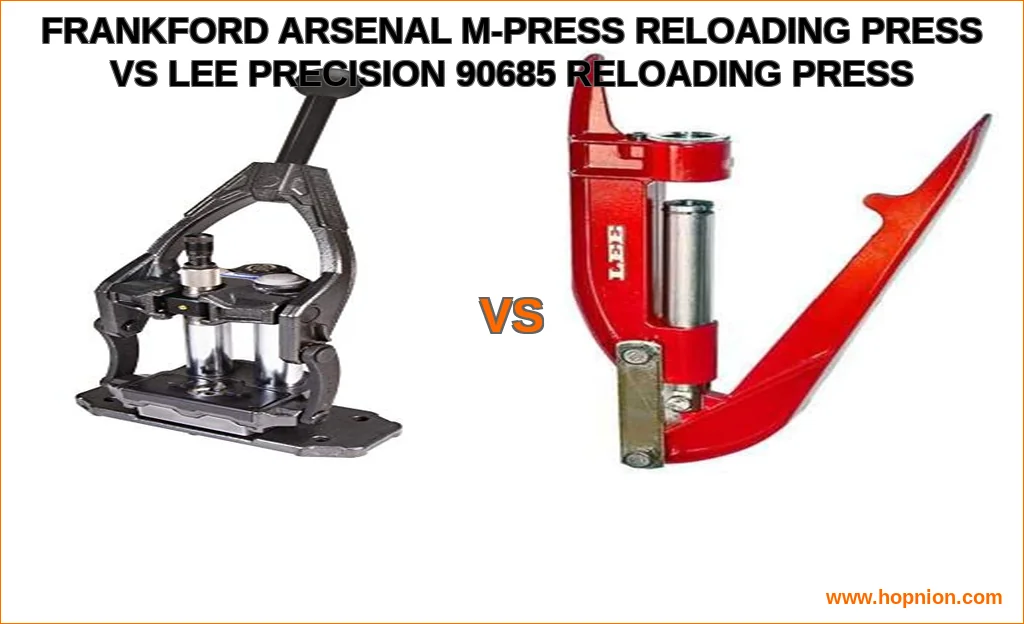
Frankford Arsenal M-Press: A Modern Coaxial Powerhouse
The Frankford Arsenal M-Press makes a statement before you even mount it. Weighing in at a solid 21 lbs with dimensions of 20″ L x 9″ W x 6.5″ D, its heavy-duty, robust die-cast construction promises stability. This isn’t a lightweight piece of kit. The core of its design is the coaxial, or floating, shell-holder plate. This feature, combined with two parallel guide rods, aims to keep the case and die perfectly aligned throughout the strokea key factor for consistent ammunition.
From my honest perspective, the included quick-change die blocks are a significant value-add. They fit standard 7/8″-14 dies, allowing you to pre-set your dies and swap them in seconds. The integrated spent primer disposal system, featuring a catcher and chute, is another thoughtful touch that helps keep your workspace clean. Its a press designed for a shooter who values a modern, feature-rich approach to the single stage press process.
Key Features & Considerations
- Construction: Heavy-duty die-cast. The 21 lb weight indicates a solid, vibration-resistant frame.
- Alignment: Coaxial floating shell-holder with dual guide rods for enhanced stability and potential precision.
- Convenience: Includes quick-change die blocks and a primer catcher system.
- Mounting: Its larger footprint (20″x9″) requires a sturdy, dedicated bench space.
Lee Precision 90685 Challenger: The Classic Single-Stage
The Lee Precision 90685, often called the Challenger, is a legend in budget-conscious reloading circles. Its description is straightforward: a single stage press with an aluminum frame and a bottom-center handle location. This simplicity is its greatest strength. The cast iron construction (noted in its title) in the critical linkage areas provides the necessary strength, while the aluminum frame keeps the overall weight and cost down.
My honest take is that the Lee 90685 excels in pure, no-fuss functionality. It lacks the coaxial alignment or quick-change features of the M-Press, but it offers a direct, mechanical feel that many reloaders prefer. The bottom-center handle provides a natural pushing motion. It’s a press that has served countless beginners and experts alike, proving that effective press durability doesn’t require excessive complexity or weight. For those wondering, “is the Lee 90685 good for rifle reloading,” its design has handled countless rifle cartridges for decades.
Key Features & Considerations
- Construction: Aluminum frame with a cast iron compound linkage system, offering a good balance of strength and weight.
- Design: Traditional “O” frame design with a bottom-center handle for a direct press stroke.
- Simplicity: No built-in primer disposal or quick-change systems, reflecting a minimalist philosophy.
- Mounting: Likely has a smaller footprint than the M-Press, offering more flexibility on crowded benches.
Side-by-Side: Frankford M-Press vs. Lee Challenger
Placing these two presses next to each other highlights their different approaches. Heres a direct comparison based on their stated features.
| Feature | Frankford Arsenal M-Press | Lee Precision 90685 Challenger |
|---|---|---|
| Press Type | Coaxial Single Stage | Traditional Single Stage |
| Frame Material | Heavy-Duty Die-Cast | Aluminum Frame |
| Key Mechanism | Floating Shell-Holder, Dual Guide Rods | Cast Iron Compound Linkage |
| Weight | 21 lbs | Not Specified (Lighter) |
| Spent Primer System | Integrated Catcher & Chute | Not Included |
| Die Compatibility | 7/8″-14 (with quick-change blocks) | Standard 7/8″-14 |
| Handle Location | Not Specified | Bottom Center |
| Dimensions | 20″ L x 9″ W x 6.5″ D | Not Specified (Compact) |
| Check current price on Amazon | Check current price on Amazon |
Diving Deeper: Use Cases and Long-Term Value
This reloading equipment comparison must go beyond specs. I honestly believe your specific goals dictate the winner. For a shooter meticulously developing loads for a precision rifle or wanting the convenience of preset die blocks for calibers like 9mm, the Frankford M-Press’s coaxial design and features are compelling. The question of Frankford Arsenal M-Press durability long term review prospects look good given its mass and construction, but its complexity means more potential points for maintenance.
The Lee Challenger is the archetypal reloading for beginners press. Its lower price point, simplicity, and proven track record make it a low-risk entry. It forces you to learn the fundamentals without automation. The availability of replacement parts for Lee presses is typically excellent, a crucial factor for long-term ownership. For high-volume pistol shooting, like in a Frankford Arsenal M-Press vs Lee Challenger for 9mm scenario, the Lee’s speed might be limited by its single-stage nature, but its reliability is unquestioned.
Mounting requirements are a practical divider. The M-Press needs a stout, permanent bench due to its size and weight. The Lee’s lighter build offers more flexibility, perhaps even allowing for a temporary mounting solution. When considering the best single stage press under $150, the Lee 90685 is often the default champion, but the M-Press contends
Verdict: Which Reloading Press is Right for You?
So, which press is better? The answer isn’t universal. It hinges on your priorities.
Choose the Frankford Arsenal M-Press if: You value modern engineering features like coaxial alignment and quick-change die blocks. You have a dedicated, sturdy bench and prefer a press with an integrated spent primer disposal system. Your focus is on achieving high levels of consistency, and you appreciate a heavier, more solid feel. You’re willing to invest a bit more for these conveniences in your reloading setup.
Choose the Lee Precision 90685 Challenger if: Your primary concern is value for money and getting started without a large investment. You prefer simplicity, proven design, and easy access to replacement parts. Your bench space is limited or you need a more portable mounting option. You don’t mind adding an aftermarket primer catcher and you enjoy the hands-on, fundamental process of reloading. For a deeper look at Lee’s approach to precision, our other comparisons are useful.
Honest to goodness, both are capable tools. The Frankford M-Press is like a modern precision vise, while the Lee Challenger is a timeless hammerboth build, but with different feels. Your shooting discipline matters, too. For ultimate rifle precision, the M-Press’s alignment features are attractive. For general-purpose reloading, the Lee’s efficiency is hard to beat.
Before purchasing any press, consult reloading manuals from trusted sources like Hornady or RCBS. Always follow safe reloading practices as outlined by authoritative guides. My final honest assessment is this: you can’t make a bad choice here, only a choice that’s better or worse for your specific situation. Consider how you’ll use it, where you’ll put it, and what you truly need from your firstor nextpress. That’s the Honest Opinion that will steer you right.