

Two names consistently surface when shooters look for a capable, foundational single stage press: the Frankford Arsenal M-Press and the Hornady Lock-N-Load Classic. Both promise to turn components into precision ammunition on your reloading bench, but they approach the task with distinct philosophies. One emphasizes a modern, rigid design, while the other banks on a legendary quick-change system. Choosing between them isn’t just about specs; it’s about matching a tool to your reloading personality and goals.
Honest OpinionThis direct comparison cuts through the marketing. We’ll examine the actual construction, features, and real-world implications of each press’s design. Whether you’re assembling a reloading kit for the first time or seeking an upgrade for dedicated case prep, the right choice here sets the tone for your entire process. My honest assessment is that both are excellent, but they serve slightly different masters.
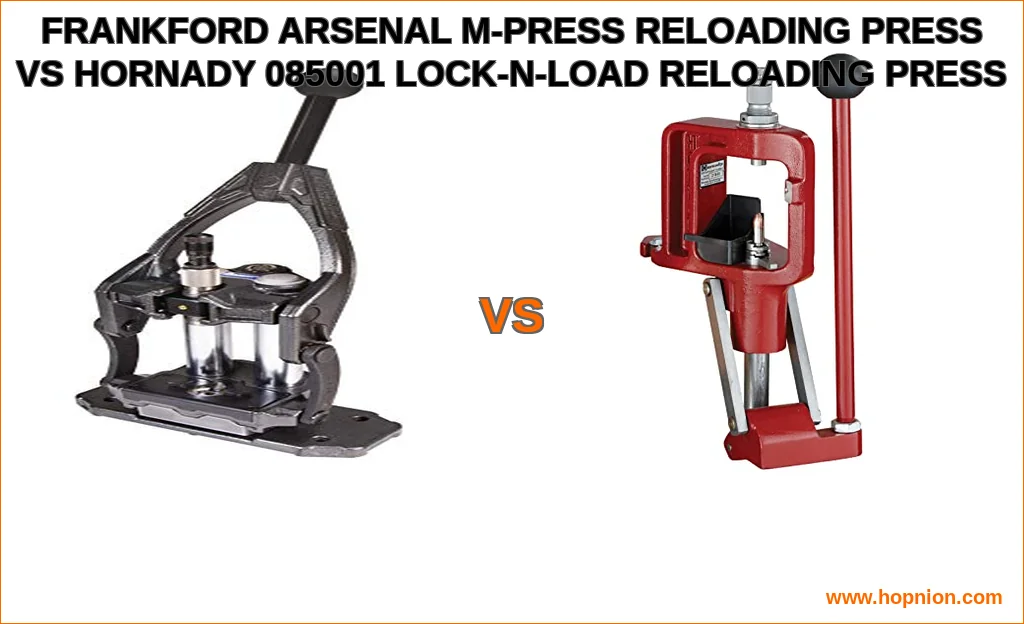
Head-to-Head Overview: M-Press vs Lock-N-Load
At first glance, these are two very different machines. The Frankford Arsenal M-Press presents a modern, almost industrial profile with its parallel guide rods and floating shell holder. It’s a single stage press built like a tank, weighing in at a substantial 21 lbs with dimensions of 20″ L x 9″ W x 6.5″ D. This heft isn’t for show; it’s for damping vibration and providing a rock-solid foundation for every operation, from resizing to bullet seating.
The Hornady 085001 Lock-N-Load Classic, in contrast, carries the legacy of a proven design. Its iconic red frame is a familiar sight in reloading rooms worldwide. The star of the show is its namesake Lock-N-Load bushing system, which promises tool-less die changes. It comes with three of these bushings and a primer catcher right out of the box. Honestly speaking, if speed and convenience in switching calibers are your top priorities, the Hornady’s core feature is immediately compelling.
Detailed Feature Breakdown & Specifications
Let’s get into the nuts and bolts. A side-by-side look reveals how each manufacturer prioritizes different aspects of the reloading experience.
| Feature | Frankford Arsenal M-Press | Hornady Lock-N-Load Classic |
|---|---|---|
| Core Design | Coaxial press with floating shell holder & 2 parallel guide rods | Traditional “O” frame press with compound linkage |
| Die Compatibility | Accepts standard 7/8″-14 dies via included quick-change die blocks | Accepts standard 7/8″-14 dies via Lock-N-Load bushings (3 included) |
| Primer System | Integrated spent primer catch system | Comes with a primer catcher |
| Construction | Heavy-duty die-cast; 21 lbs | Cast iron “O” frame; weight not specified in provided data |
| Key Claimed Advantage | Stability and alignment from guide rod system | Speed and convenience from bushing system |
| Check current price on Amazon | Check current price on Amazon |
The M-Press’s coaxial design is its defining trait. The shell holder floats on those two guide rods, theoretically promoting perfect alignment between the shell holder and the reloading dies every time. This is a feature often sought for ultimate precision. The Hornady relies on its robust compound linkage for smooth operation and mechanical advantage, a time-tested approach used by brands like RCBS and Lyman.
Covering the Nuances: Warranty, Noise, and Caliber Fit
Many comparisons stop at the physical specs, but the long-term experience hinges on other factors. From my honest perspective, warranty and customer service are part of the value for money equation. Frankford Arsenal typically offers a limited lifetime warranty, while Hornady is known for its strong customer supporta point worth verifying on their respective websites as an official source.
Noise and vibration dampening is another subtlety. The M-Press’s mass and design likely absorb more shock and sound during operations like primer seating and resizing. The Hornady’s rigid frame is effective, but heavier presses generally transmit less vibration to the bench. For specific caliber compatibility, both handle standard cartridges with ease. However, the Hornady system means you need a Lock-N-Load bushing for every die you want to quick-change, an ongoing cost if you load many calibers.
Performance Comparison: Precision, Speed & Usability
How do these features translate to the bench? For precision-focused reloading, the argument often favors the M-Press. Its guided, coaxial motion is engineered to minimize runoutthe enemy of consistent accuracy. If your goal is producing match-grade ammunition where every thousandth counts, this engineered alignment is a significant theoretical advantage. I honestly believe the M-Press’s design speaks directly to the meticulous reloader.
For speed and workflow efficiency, the Hornady Lock-N-Load has a clear edge. The ability to pop a die out and lock a new one in without touching a wrench is a game-changer for processes that involve frequent die changes. Think of decapping, then switching to a resizing die, then a charging die, then a seating die. That process is noticeably faster. For the reloader who values a streamlined process or produces batches of different cartridges in one session, this convenience is hard to beat.
Usability for beginners is excellent for both, but in different ways. The Hornady’s simple bushing system is intuitive from day one. The Frankford M-Press might have a slight learning curve with its floating shell holder, but its solid feel is confidence-inspiring. Both include a primer catch system, a critical feature for maintaining a clean workspace.
Pros & Cons Summary for Each Press
To crystallize the choice, heres an honest breakdown of strengths and weaknesses.
Frankford Arsenal M-Press
- Pros: Exceptional frame rigidity and potential for superior alignment. Heavy construction dampens vibration. Integrated spent primer management is robust. Comes ready for standard dies.
- Cons: Significantly heavier (21 lbs), affecting portability. Die changes require loosening a set screw, slower than a bushing system. The modern design may not appeal to traditionalists.
Hornady Lock-N-Load Classic
- Pros: The legendary Lock-N-Load bushing system enables incredibly fast die swaps. Proven, reliable compound linkage design. Includes three bushings, offering immediate multi-die functionality. A trusted name with wide aftermarket support.
- Cons: The bushing system adds cost for every additional die station. Some users report a very slight “float” in the bushing, though its effect on precision is debated. The design, while proven, lacks the modern guided alignment of a coaxial press.
Final Verdict: Who Should Buy Which?
So, which is better: the Frankford Arsenal M-Press or Hornady Lock-N-Load? The answer isn’t universal. It depends entirely on what you value most at your reloading bench.
Choose the Frankford Arsenal M-Press if: You prioritize potential precision above all. You are a detail-oriented reloader willing to trade a bit of speed for a press engineered for perfect alignment. You appreciate massively built tools and want a press that feels absolutely solid during every operation. You don’t mind a slightly slower die-change process. For precision reloading, the M-Press makes a compelling case.
Choose the Hornady Lock-N-Load Classic if: Your workflow values speed and convenience. You frequently switch between calibers or reloading dies during a session. You prefer a time-tested design with a vast ecosystem of accessories and support. You want a system that simplifies the process, making it fantastic for beginners or those who reload a wide variety of cartridges. The ease of use in Hornady Lock-N-Load vs Frankford M-Press is a tangible advantage here.
My honest take is that there is no wrong choice, only a right choice for your needs. The Frankford is the specialist’s tool, built for a singular focus on consistency. The Hornady is the efficient workshop partner, built to adapt and streamline. Both will produce excellent ammunition for years. Your Honest Opinion on what matters most in your reloading journey is the final factor. Consider your typical session, your patience for setup, and your end goal. Then, invest in the tool that aligns with your shooting ambitions.