

Two turret presses consistently dominate conversations among reloaders looking to step up their game. The Frankford Arsenal Precision Turret Press and the Lee Precision 90932 represent two distinct philosophies in reloading equipment. One offers robust construction and capacity, while the other champions a streamlined, automated approach. Deciding between them shapes your entire reloading bench setup.
This isn’t just about picking a tool; it’s about choosing a workflow that matches your volume, caliber variety, and patience for setup. My honest assessment is that both are excellent values, but they cater to different priorities. Let’s break down their actual features to see which press might earn a permanent spot on your bench.
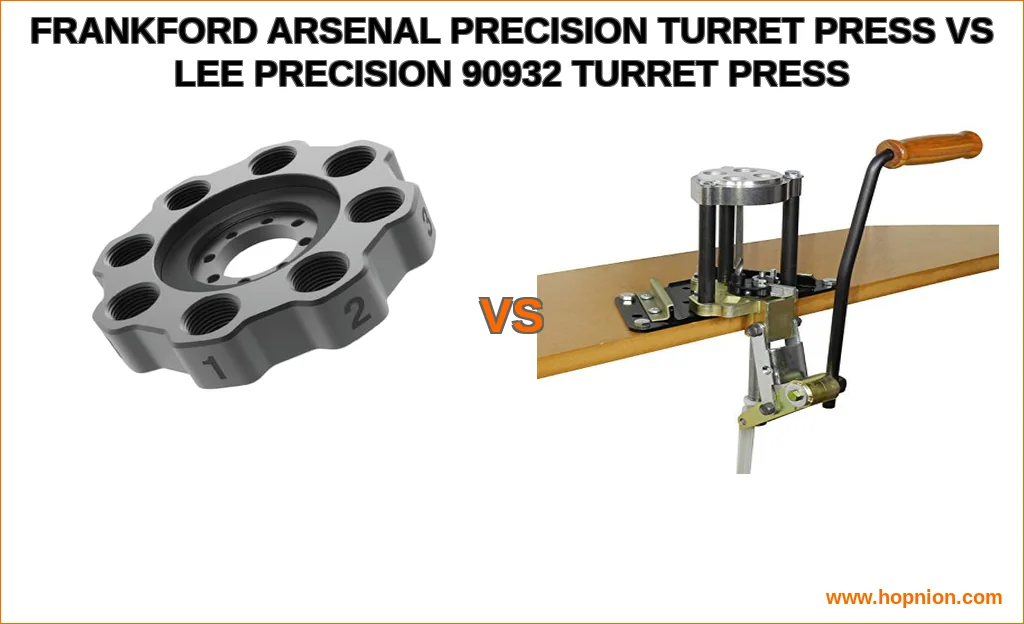
Head-to-Head Feature Comparison
Seeing the core specifications side-by-side reveals their fundamental differences. This table lays out what each press offers straight from the manufacturer.
| Feature | Frankford Arsenal Precision Turret Press | Lee Precision 90932 Turret Press |
|---|---|---|
| Turret Design | 8-Station, Includes one extra turret | 4-Hole Turret |
| Key Mechanism | Manual indexing (implied by feature set) | Auto Index system |
| Construction | Precision cast steel | Cast aluminum |
| Caliber Swapping | Designed for quick and easy conversion | Integrated with auto-index system |
| Die Compatibility | Accepts standard 7/8″ x 14 dies | Accepts standard 7/8″ x 14 dies |
| Primary Benefit | Durability and elimination of flex | Automated turret rotation |
| Check current price on Amazon | Check current price on Amazon |
Breaking Down the Build: Steel vs. Aluminum
The construction material is the first major differentiator. Frankford Arsenal uses precision cast steel, a choice explicitly made for eliminating movement and flex. This translates directly to enhanced consistency, which is the bedrock of accuracy. For someone chasing tight groups, that rigidity is a tangible benefit.
The Lee Classic Turret, conversely, is built from cast aluminum. Honestly speaking, this isn’t a mark against it; it’s a design choice that keeps weight and cost down while still providing sufficient strength for the forces involved in pistol and standard rifle cartridges. The question becomes one of long-term feel and perceived sturdiness under heavy use.
The Heart of the Operation: Indexing System & Workflow
This is where these presses truly diverge. The Lee’s auto indexing system is its headline feature. The turret automatically rotates to the next station with each stroke of the handle. This creates a semi-progressive rhythm that can significantly boost output for straight-walled pistol cartridges like 9mm, making a strong case for the easiest turret press to use for 9mm.
The Frankford Arsenal M-Press, with its eight stations and manual indexing, offers a different kind of efficiency. The extra real estate allows for more complex die setups or the use of dedicated stations for tools like a powder cop or bullet feeder die. Caliber swapping is highlighted as quick and easy, likely due to the included extra turret head. You can pre-set dies for two calibers and switch in seconds.
Durability, Maintenance, and Real-World Use
Thinking beyond the first 100 rounds is crucial. The cast steel frame of the Frankford Arsenal suggests a press built for decades of service with minimal wear. Speaking honestly, that kind of build often requires less adjustment over time, as components are less likely to loosen or develop play.
The aluminum Lee press is certainly durable for its intended use, but long-term maintenance might involve more frequent checks on the indexing system mechanism to ensure it remains smooth and precise. A point often overlooked in turret press reviews is spent primer management. Examining how each press handles this messy but essential task is key. Does it have a contained primer catcher or a tube that directs debris away from your workspace? This detail greatly impacts the cleanliness of your reloading process.
Warranty and customer support are silent but critical entities. Frankford Arsenal and Lee Precision both have reputations in the industry, but their response times and policy details are worth a quick search before purchase. consider compatibility. If you plan to mount your press on a sophisticated bench, check its compatibility with popular aftermarket mounting systems from companies like Inline Fabrication for enhanced ergonomics.
Speed, Efficiency, and the Learning Curve
Which turret press is better for beginners? Honestly, I believe the answer isn’t universal. The Lee’s auto-index is incredibly forgiving and helps build muscle memory for the reloading sequence. It practically guides you through the steps, reducing the chance of a double-charge or other error due to skipped stations.
The Frankford Arsenal’s manual process requires more user control, which can be a pro or a con. It allows for more deliberate, inspect-as-you-go reloading, which some beginners prefer for learning the fundamentals of each stage. However, the eight-station capability is arguably overkill for a novice loading a single pistol caliber. The speed advantage comes into its own when loading rifle cartridges requiring more steps or when using multiple calibers in a single session.
For a deep dive into another precise option from Frankford Arsenal, our frankford coaxial press review explores a different design philosophy altogether.
Price, Value, and What’s in the Box
The value proposition is clear-cut. The Lee 90932 typically comes at a lower entry price, offering its automated system as the core value. It’s often sold as part of reloading kits that include dies, a scale, and other essentials, making it a compelling one-stop shop.
The Frankford Arsenal Precision Turret Press positions itself as a premium tool. The extra turret head is a significant value-add, effectively giving you two complete, pre-set tool heads. When you factor in the steel construction and higher station count, the price difference reflects a different tier of reloading equipment. You’re paying for flexibility and a heftier foundation.
To be completely honest, the best value is the press you’ll use most effectively. A cheaper press that frustrates you is a poor investment, while a more expensive one that doesn’t utilize its advanced features is overkill. Consider your caliber needs: if you only load 9mm and .223, the eight stations may be unused capacity. If you juggle .308, 6.5 Creedmoor, and several pistol calibers, that extra turret and quick-change become priceless.
Final Verdict: Matching the Press to the Shooter
So, who wins in the Frankford Arsenal vs Lee turret press accuracy debate? Honestly, both are capable of producing highly accurate ammunition. The potential accuracy edge from the Frankford’s steel frame is real, but only realized with meticulous technique and quality components. The Lee is more than accurate enough for the vast majority of shooting disciplines.
My honest take is this:
- Choose the Lee Precision 90932 if you prioritize a simple, automated workflow for high-volume pistol reloading, are a beginner wanting a guided process, or have a strict budget. Its auto-index is a brilliant feature for streamlining repetitive tasks.
- Choose the Frankford Arsenal Precision Turret Press if you value ultra-sturdy construction, need to manage multiple rifle and pistol calibers efficiently, want the flexibility of eight stations for specialty dies, and see yourself as a long-term reloading enthusiast. Its design is about maximizing flexibility and minimizing compromise.
For another perspective on precision in reloading, our comparison of the precision focus of different press types is useful. Remember, the best resource is always the manufacturer’s manual and trusted official source for load data.
Ultimately, your reloading press is the cornerstone of your operation. Whether you lean towards the automated simplicity of the Lee or the robust versatility of the Frankford Arsenal, you’re getting a capable tool. The right choice amplifies your enjoyment of the craft. And for more unfiltered gear analysis like this, you can always find it at the Honest Opinion hub. Now, get out there and make some rounds.