

Two distinct philosophies of ammo reloading sit on the bench today. On one side, the methodical, precise world of the turret press. On the other, the high-output realm of the progressive press kit. The Frankford Arsenal Precision Turret Press and the Lee Precision Pro 4000 Press Kit represent these two paths perfectly. Choosing between them isn’t about finding a “best” press, but the right tool for your specific reloading goals, budget, and bench space.
This head-to-head breaks down their core differences. We’ll examine build quality, operational speed, and the overall user experience each one delivers. From the initial setup to the final crimp, se machines is key to making an informed investment for your reloading bench.
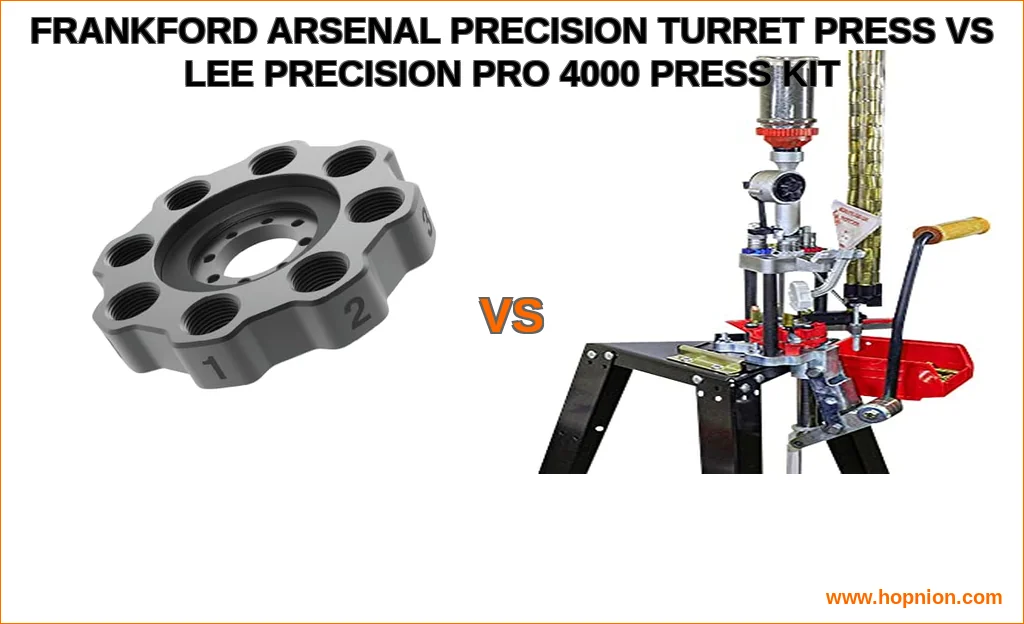
Head-to-Head Overview & Specifications
At their core, these are fundamentally different machines designed for different workflows. The Frankford Arsenal is an 8-station turret press, a system built for deliberate, single-stage-like precision with the convenience of pre-mounted dies. The Lee Pro 4000 is a true progressive press kit, engineered to automate multiple operations with each pull of the handle for maximum volume.
| Feature | Frankford Arsenal Precision Turret Press | Lee Precision Pro 4000 Press Kit |
|---|---|---|
| Press Type | 8-Station Turret Press | Progressive Press Kit |
| Core Design Philosophy | Precision & Flexible Caliber Swapping | Speed & Modular Automation |
| Key Operation | Manual indexing system (turret rotates) | Auto-indexing shellplate |
| Included Automation | N/A (Turret-based) | Auto case placer, through-ram primer disposal |
| Caliber Change Focus | Quick turret head swap | Seconds, including primer size |
| Die System | Accepts standard 7/8″-14 dies | Breech Lock quick-change bushings |
| Check current price on Amazon | Check current price on Amazon |
Feature-by-Feature Breakdown
Reloading Speed & Efficiency
This is the most dramatic difference. The Lee Pro 4000 is built for output. Its progressive design, with an auto case placer and auto-indexing shellplate, aims to produce a finished round with every stroke. The promise is high-volume reloading with minimal handling. Honestly speaking, if your goal is pumping out hundreds of rounds for a range session, the progressive action is hard to beat.
The Frankford Arsenal turret press operates differently. It’s a hybrid. You complete one operation per handle pull, but the 8-station turret head holds all your dies. You manually index to the next station. It’s significantly faster than a single-stage but won’t match a progressive’s pace. The efficiency here is in streamlined workflow, not raw speed. You’re never removing the case until it’s a complete cartridge.
Ease of Use & Setup
Lee emphasizes simplicity with its “no adjustments” mantra. The Pro 4000 kit includes everything needed to start reloading a specific caliber (like .223 Remington as listed). Its modular construction is a highlight; you can start manually and add automation like a case feeder later. The breech lock bushings allow for rapid die changes without re-adjusting settings, a boon for beginners wary of complex setup.
The Frankford Arsenal’s ease comes from a different angle: organized simplicity. Caliber conversion is its superpower. Swapping the entire pre-loaded turret head makes changing calibers incredibly fast. You keep your dies perfectly adjusted. From my honest perspective, this is a huge advantage for reloaders who work with multiple pistol or rifle calibers regularly and value a tidy, ready-to-go setup.
- Lee Pro 4000: Focuses on a streamlined, automated process out of the kit. Includes priming arms, case ejector wire, and tool storage.
- Frankford Arsenal Turret: Focuses on caliber management and rock-solid stability during the reloading stroke.
Build Quality & Durability
Frankford Arsenal highlights “precision cast steel construction” designed to eliminate movement and flex. This speaks to a press built for consistent, accurate ammunition. A rigid press is a precise press. The feel is often more substantial, which can translate to smoother operation and better primer seating consistency.
The Lee Pro 4000 uses a different approach, prioritizing functional, cost-effective design that enables its progressive features. My honest assessment is that while it may not have the same heft as a cast-steel turret press, its design is proven and its durability is well-regarded within its price class. The included primer catcher system (the disposal tube) is a thoughtful touch for bench cleanliness.
Bench mounting requirements differ here. The Frankford Arsenal, with its cast steel build, will be heavier and may require a more robust bench or mounting system to handle its torque and footprint without vibration. The Lee, while still needing secure mounting, might be more forgiving on a lighter setup.
Performance: Consistency & User Experience
The Precision Factor
For match-grade ammunition where every thousandth counts, the press’s rigidity is paramount. The Frankford Arsenal’s design philosophy is rooted in this. it ensures the force of your handle pull goes directly into the sizing or seating operation, not into bending the frame. This can lead to superior consistency, especially for rifle cartridges. If you want my honest opinion, for a dedicated precision reloading workflow, the turret press architecture has inherent advantages.
The Lee Pro 4000 can produce excellent ammunition, but its consistency is tied to the smooth function of its indexing system and shellplate. Proper setup and maintenance are key. The benefit is that you’re achieving this consistency at a much higher rate of production. It’s a balance between volume and verifiable accuracy.
Noise, Vibration, and Feel
This is a missing entity in many comparisons. A turret press like the Frankford Arsenal tends to have a solid, dampened feel with less clatter. The action is simpler. A progressive press involves more moving partsthe shellplate indexing, the case feeder arm (if used), the primer system. This can mean more noise and vibration. For some, the rhythmic clunk of a progressive is the sound of productivity. For others working in a shared space, a quieter turret may be preferable.
Caliber Conversion & Cost
This is critical for long-term value.
- Frankford Arsenal: You buy an extra turret head for each caliber set (~$40-$60). Your standard dies screw in once and stay. Conversion cost is relatively fixed and simple.
- Lee Pro 4000: You need a new shellplate, potentially a new primer arm size, and a set of dies. The breech lock bushings are reusable. The initial kit is comprehensive, but adding calibers involves purchasing several specific components.
Speaking honestly, the best value progressive reloading press kit is the one that aligns with your caliber needs. If you reload one or two calibers in bulk, the Lee kit is tremendous value. If you load six different calibers, the turret system’s conversion ease becomes a major financial and logistical advantage.
Final Verdict: Best Use Cases & Recommendations
So, which is better: Frankford Arsenal or Lee Precision press? The answer depends entirely on you.
Choose the Frankford Arsenal Precision Turret Press if:
- You prioritize ammunition consistency and precision over sheer speed.
- You reload for multiple calibers and want the fastest, simplest changeover.
- You appreciate a robust, solid-feeling machine with minimal flex.
- Your workflow is methodical, and you enjoy the hands-on process of each stage.
- You’re a beginner who wants a simpler mechanical system to learn on, a strong contender for the easiest to use press for beginner reloaders seeking a middle ground.
Choose the Lee Precision Pro 4000 Press Kit if:
- Your primary goal is producing high volumes of ammunition efficiently.
- You mainly reload one or two calibers in bulk (like .223/5.56 or 9mm).
- You want the ability to start simple and add automation like a case feeder later.
- You value the included “kit” aspect that gets you started with necessary components.
- The “no adjustments” design philosophy appeals to your desire for a streamlined process.
Both brands stand as pillars in the reloading community. For deeper dives into their engineering, always consult your reloading manual and manufacturer resources like the official source from Hornady or the authority guide from RCBS for foundational knowledge.
In my honest opinion, I believe the heart of the decision lies in your personal reloading rhythm. Are you a high-volume shooter needing to feed several firearms regularly? The Pro 4000’s progressive nature is compelling. Are you a meticulous shooter developing loads for hunting, competition, or long-range accuracy? The Frankford Arsenal’s stability and caliber-swap elegance will likely serve you better. There’s no universal winner, only the right tool. And for more unfiltered takes on gear like this, you can always find an Honest Opinion waiting.
Before purchasing, consider your bench’s reality. Measure your space, think about your mounting solution (companies like Inline Fabrication offer great upgrades), and be realistic about your caliber needs. Your perfect press is the one that gets used, not the one that becomes a complicated bench ornament. Happy reloading.