

Two distinct philosophies of reloading sit on the bench. On one side, the methodical, deliberate process of a turret press. On the other, the streamlined, high-volume workflow of a progressive machine. The Frankford Arsenal Precision Turret Press and the Dillon Precision RL550C represent these two worlds perfectly. For anyone deciding between them, the choice isn’t just about toolsit’s about how you want to spend your time at the bench.
This comparison cuts through the noise. We’ll examine the core design, real-world performance, and long-term value of each press. My honest assessment is that both are excellent, but they serve fundamentally different reloaders. Let’s get into the details.
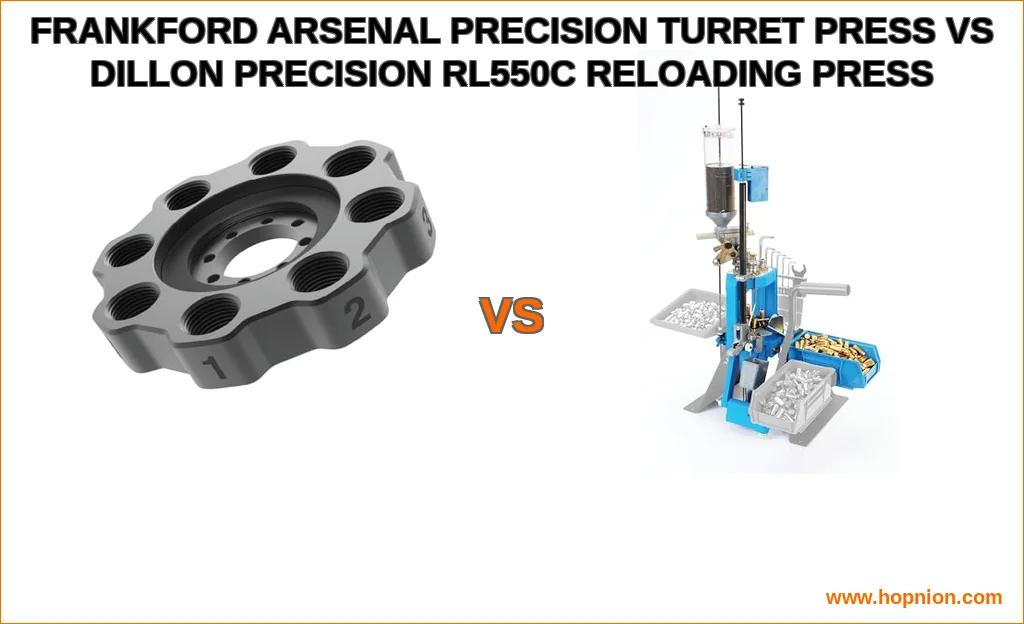
Head-to-Head: Press Type & Core Design Philosophy
The fundamental difference is the operational cycle. The Frankford Arsenal is a turret press. It features an 8-station rotating turret head that holds all your dies. You complete all operations on a single case before manually rotating the turret to the next station. This is, in essence, a highly efficient form of single-stage operation.
The Dillon RL550C is a manual-indexing progressive press. Four stations are arranged on a rotating shellplate. With each pull of the handle, a case moves to the next station, allowing you to perform a different operation on up to four cases simultaneously. You manually advance the shellplate, giving you control over each stage’s progression.
Detailed Feature Breakdown & Comparison
Heres a direct look at how these presses stack up based on their stated features.
| Feature | Frankford Arsenal Precision Turret Press | Dillon Precision RL550C |
|---|---|---|
| Press Type | 8-Station Turret Press | Manual-Index Progressive Press |
| Core Design | Precision cast steel for minimal flex; focuses on reloading precision through a controlled, single-case process. | Combines precision reloading with progressive speed; built for durability with a greaseable pivot pin. |
| Caliber Conversion | Quick-swap turret system. An extra turret is included for dedicated setups. | Removable toolhead system keeps dies and powder settings intact for fast changes. |
| Die Compatibility | Accepts standard 7/8″-14 dies universally. | Accepts standard 7/8″-14 dies. |
| Primer System | Manual case priming (feature not detailed in provided specs). | Integrated priming system (implied by progressive design). |
| Powder System | Typically uses a separate powder measure. | Includes a case-activated powder measure that dispenses only when a case is present. |
| Indexing | Manual turret rotation. | Manual shellplate advancement. |
| Check current price on Amazon | Check current price on Amazon |
Performance Analysis: Speed, Precision, and Ease of Use
Reloading Speed & Volume
This is the most straightforward differentiator. The Dillon RL550C is built for higher output. a skilled user can achieve significantly higher rounds-per-hour rates. It’s the clear winner for volume shooting disciplines.
The Frankford Arsenal turret press is faster than a true single-stage but operates on a one-case-at-a-time principle. Its speed gain comes from not swapping diesyou rotate the turret. Honestly speaking, it’s ideal for the reloader who values process over pure production, perfect for meticulous rifle rounds or moderate-volume pistol loading.
User Experience & Ease of Use
Setup complexity favors the turret press. The Frankford Arsenal is incredibly straightforward. You screw in your dies, set them once, and you’re largely done. Its simplicity is a major value proposition for beginners. The question of which is better for beginner reloaders Frankford Arsenal or Dillon often comes down to this: the turret offers a gentler, more educational learning curve.
The Dillon RL550C has a steeper initial setup. Adjusting the four stations, the primer system, and the case-activated powder thrower requires more patience. However, once dialed in, its workflow is remarkably smooth. The manual indexing provides a crucial safety checkpoint, letting you visually verify each operation.
Reloading Precision
Both presses are capable of excellent accuracy. The Frankford Arsenal’s rigid, cast-steel construction is designed to “eliminate all movement and flex for enhanced accuracy.” This focused design on a single case can be beneficial for precision rifle shooters who measure every charge.
The Dillon is engineered for “repeatability of precision reloading.” Its robust frame ensures consistent operation across thousands of rounds. For most pistol calibers and even many rifle applications, the precision difference is negligible. The consistency of its case-activated powder measure is a huge asset for reloading precision at speed.
Cost Analysis: Initial Investment & Long-Term Value
The upfront cost is just the beginning. A true cost of ownership comparison Frankford vs Dillon press must consider accessories and scalability.
The Frankford Arsenal press often has a lower entry price and includes an extra turret. You’ll need to purchase a separate powder measure and primer tool, but the total can still be very competitive. Its universal die acceptance means you can use any brand, including Dillon dies. So, can you use Dillon dies in Frankford Arsenal turret press? Absolutely.
The Dillon RL550C is a larger initial investment. However, it includes a premium powder measure and priming system in the box. Dillon’s legendary “No BS” warranty and customer service add immense long-term value. Caliber conversion kits are an additional cost, but the toolhead system makes swaps incredibly fast. Speaking honestly, the Dillon becomes a lifetime investment.
: Bench Life & Maintenance
Competitors often skip practical bench considerations. The Dillon, being a progressive, requires a sturdy, well-mounted bench due to its footprint and operating torque. The Frankford Arsenal, while still solid, can work on a slightly less robust setup.
Maintenance differs too. The Dillon’s greaseable pivot pin points to a designed service schedule for long life. The Frankford’s simpler mechanism may require less frequent attention but should still be kept clean and lubricated. Noise and vibration are generally higher on a progressive press during the priming and sizing stages.
Final Verdict: Who Should Buy Which Press?
Choose the Frankford Arsenal Precision Turret Press if:
- You’re a beginner seeking an intuitive introduction to reloading.
- Your focus is on precision rifle rounds or low-to-moderate volume pistol.
- You value a simple, straightforward process and easy caliber swaps.
- Your budget is tighter upfront, and you prefer to add components over time.
- You want to read a frankford press review to see another option from the same brand.
In my honest opinion, the Frankford Arsenal is the smarter starting point for most new reloaders. It teaches proper fundamentals without overwhelm.
Choose the Dillon Precision RL550C if:
- You regularly shoot high volumes of pistol or rifle cartridges.
- You’re an experienced reloader ready to step up production without sacrificing control.
- You appreciate top-tier durability, customer support, and a system you’ll never outgrow.
- The included case-activated powder measure and priming system are worth the premium.
- You load for multiple calibers and value the quick-change toolhead system.
My honest take is that the Dillon RL550C is the ultimate “shooter’s press.” It’s a workhorse built for the long haul. For a different take on achieving precision, our comparison with Lee Precision is worth a look.
The Bottom Line
There is no single “best reloading press.” The Frankford Arsenal Turret excels in teaching precision and process. The Dillon RL550C masters efficient, high-volume production. Your shooting habits, goals, and budget will dictate the winner. Always consult your official source for load data and safety guidelines. For more gear insights and unbiased reviews, the team at Honest Opinion is always digging into the details. Now, get out there and make some ammo.