

Two distinct philosophies of reloading collide on the bench. On one side, the classic turret design, represented by the Lyman All-American 8. On the other, a modern single-stage approach with the Frankford Arsenal M-Press. This isn’t just about building ammunition; it’s about choosing a workflow that fits your mindset.
Both promise durability and performance, but they achieve it through different mechanical paths. For someone deciding between a turret press and a single stage, this reloading press showdown gets to the heart of the matter. Let’s break down this head-to-head comparison.
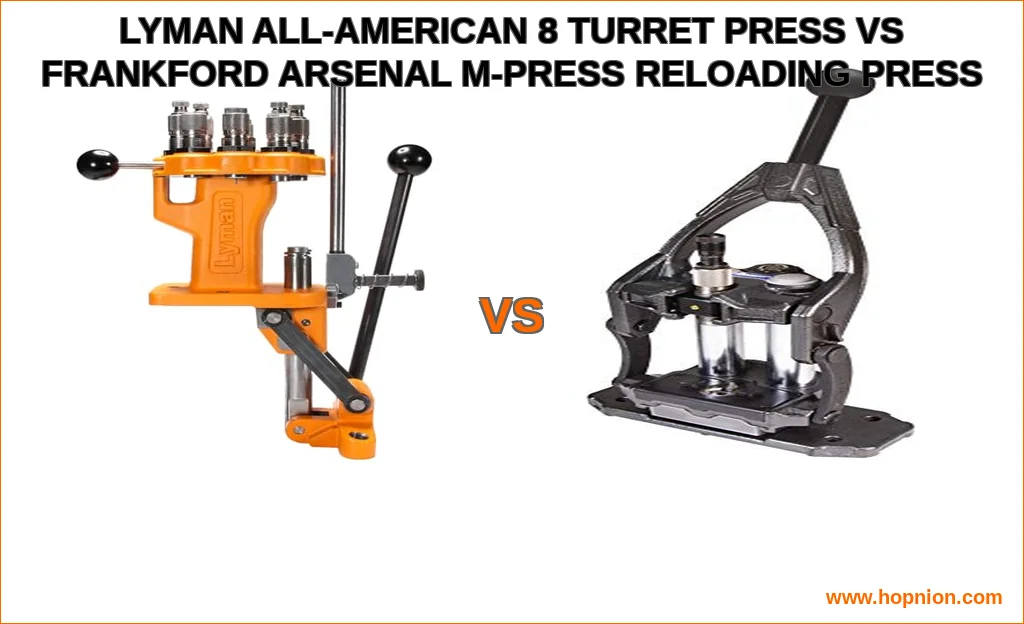
Head-to-Head: Lyman All-American 8 vs. Frankford Arsenal M-Press
Before diving into the nuances, a side-by-side look at the core specifications sets the stage. This table outlines the fundamental differences in their construction and design ethos.
| Feature | Lyman All-American 8 Turret Press | Frankford Arsenal M-Press |
|---|---|---|
| Core Design | 8-Station Turret Press | Coaxial Single Stage Press |
| Frame Material | Heavy duty cast iron | Heavy-duty, robust die-cast construction |
| Key Mechanism | Extra-large 8 station turret | 2 parallel guide rods for stability |
| Die System | Holds two complete 4-die sets | Quick-change die blocks fit standard 7/8″-14 dies |
| Primer System | Straight line primer feed with tubes | Spent primer catcher |
| Ergonomics | Easily removed turret for swapping | Integral floating shell-holder plate |
| Check current price on Amazon | Check current price on Amazon |
Turret vs. Single Stage: A Design Philosophy Clash
The fundamental divide is right there in the name. The Lyman All-American 8 is built around its rotating toolhead, an eight-station carousel that can hold multiple dies at once. This is the heart of its workflow. You set up your dies for a specific calibersay, a sizing die, expanding die, seating die, and crimp dieand then rotate the turret to bring each into position over the shell holder. The indexing mechanism is central to its operation.
Conversely, the Frankford Arsenal M-Press employs a coaxial, single-stage design. It uses compound linkage and two parallel guide rods to achieve exceptional alignment and smooth operation on a single station. You perform one operation on a batch of cases, then change the die for the next step. Its versatility comes from quick-change die blocks, not a rotating head. Honestly speaking, this makes the M-Press a master of one task at a time, while the Lyman is a conductor of a small, sequential orchestra.
What About Progressive Presses?
It’s worth noting that both of these are distinct from a progressive press. A progressive press performs multiple operations with each pull of the handle, offering the highest reloading speed for volume shooters. The turret and single-stage presses discussed here prioritize control and flexibility over raw output, making them excellent for precision reloading or for beginners who want to master each step. For high-volume calibers like .223 Remington, a progressive might be a future consideration, but mastering a turret or single-stage first builds foundational skills.
Performance Breakdown: Where Each Press Excels
Reloading Speed and Workflow Efficiency
For pure sequential processing, the Lyman All-American 8 has a clear edge. Once the turret is set, you can size, expand, seat, and crimp without touching a die. This streamlined process is a significant time-saver over a traditional single-stage. It’s a fantastic middle ground for the reloader who wants more efficiency than a single-stage but isn’t ready for the complexity and cost of a full progressive.
The Frankford Arsenal M-Press, by its single-stage nature, is inherently slower for producing finished rounds. Its speed advantage lies in its consistency and ease of die changes. If you’re processing brass in large batchessizing 500 cases, then priming them all off-press, then charging and seatingthe M-Press’s smooth, reliable operation shines. My honest assessment is that the “speed” metric depends entirely on your chosen workflow.
Precision Reloading and Ergonomics
Precision starts with alignment. The M-Press’s coaxial design and guided ram are engineered for near-perfect die alignment with every stroke. The integral floating shell-holder plate further enhances this This is a boon for consistency, especially for rifle cartridges like .308 Winchester where shoulder bump and neck tension are critical.
The Lyman’s turret design is robust, but the indexing mechanism introduces a variable that must remain true for precision. A well-machined turret will index consistently, but it’s a different path to alignment than a coaxial press. Ergonomically, the Lyman keeps your hands in one place, while the M-Press requires more handling between operations. Both have solid spent primer management systems, a small but crucial detail for a clean reloading bench.
Press Durability and Long-Term Use
Both presses are built to last. The Lyman’s heavy-duty cast iron frame and turret are industry-proven materials. The potential long-term maintenance point on a turret press revolves around the indexing detent or mechanism, though these are generally robust. The Frankford’s die-cast construction feels substantial, and the guided rod system has fewer moving parts subject to wear.
From my honest perspective, durability is less about failure and more about maintaining precision over thousands of cycles. The M-Press’s design minimizes lateral flex, while the Lyman’s mass absorbs the stress. For the average reloader, both will outlast their ownership. You can find more detailed insights in our dedicated frankford press review.
Target Audience: Who Should Buy Which Press?
The Case for the Lyman All-American 8 Turret Press
This press is ideal for the reloader who values an efficient, streamlined process for pistol calibers or moderate-volume rifle loading. It’s arguably one of the best turret press for a beginner reloader who plans to grow into multiple calibers. Buying extra turrets allows you to have a dedicated, pre-set toolhead for 9mm, .223 Remington, and .308 Winchester, swapping them in seconds.
- You want faster batch processing than a single-stage allows.
- You load multiple calibers and appreciate quick changeovers.
- Your focus is on handgun ammo or hunting rifle rounds where ultra-benchrest precision is secondary to consistency and efficiency.
- The primer catch system and included feed tubes offer a complete, ready-to-run package.
Honest to goodness, if your goal is to move from a single-stage to something faster without going full progressive, this Lyman 8 station turret press price represents a strong value.
The Case for the Frankford Arsenal M-Press
This press caters to the meticulous reloader. It’s for the shooter who processes brass in distinct, large batches and prioritizes flawless operation at each stage. Its strength lies in its sublime feel and alignment.
- You are a precision rifle shooter focused on long-range accuracy.
- You prefer a batch-processing workflow (e.g., size/decap all, then prime all, then seat all).
- You appreciate exceptional smoothness and mechanical feel.
- You want a press that excels at all aspects of case preparation, from sizing to bullet seating.
I honestly believe the M-Press pros and cons lean heavily towards the precision-focused user. While some early users discussed Frankford Arsenal M-Press durability issues, the current design appears solid. It’s a specialist tool for a specialist mindset. For another angle on achieving high precision, our comparison with Lee Precision is worth a look.
Final Verdict: Making Your Choice
So, which is better: Lyman All-American 8 or Frankford Arsenal M-Press? The answer lives in your reloading goals.
Choose the Lyman All-American 8 Turret Press if you seek a versatile, efficient workhorse. It bridges the gap between single-stage and progressive presses beautifully. It’s for the reloader who wants to produce quality ammunition with less handling and faster changeovers between calibers. The upfront investment in extra turrets pays dividends in time saved.
Choose the Frankford Arsenal M-Press if your paramount concern is mechanical perfection and consistency for each individual reloading step. It’s the press for the precision enthusiast who finds satisfaction in the process itself. Its coaxial design offers a level of alignment that is hard to match, making it a superb tool for rifle cartridges where tiny variances matter.
Both are capable of producing excellent ammunition. The Lyman optimizes for a faster, more integrated workflow. The Frankford Arsenal optimizes for the feel and precision of each individual operation. Your decision hinges on which of those philosophies resonates with your time at the reloading bench. For more gear insights and unbiased takes, the team at Honest Opinion is always digging into the details. Remember to consult official reloading manuals from sources like Hornady or RCBS for load data, and consider accessories from companies like Inline Fabrication to enhance your setup.