

Two names consistently pop up when reloaders debate powered case trimmers: Lyman and Frankford Arsenal. Each promises to streamline the tedious process of brass trimming, but they take fundamentally different approaches. The choice between them isn’t just about cutting brass; it’s about your workflow, your budget, and your tolerance for setup time. This head-to-head look cuts through the marketing to give you the real-world details.
For the precision rifle shooter, every thousandth of an inch matters. For the high-volume reloader, speed is king. And for the beginner, simplicity is everything. So, which system delivers? We’re putting the Lyman Brass Smith Case Trim Xpress against the Frankford Arsenal Universal Precision Case Trimmer. Honest to goodness, the right tool can transform your case prep from a chore into a satisfying part of the reloading process.
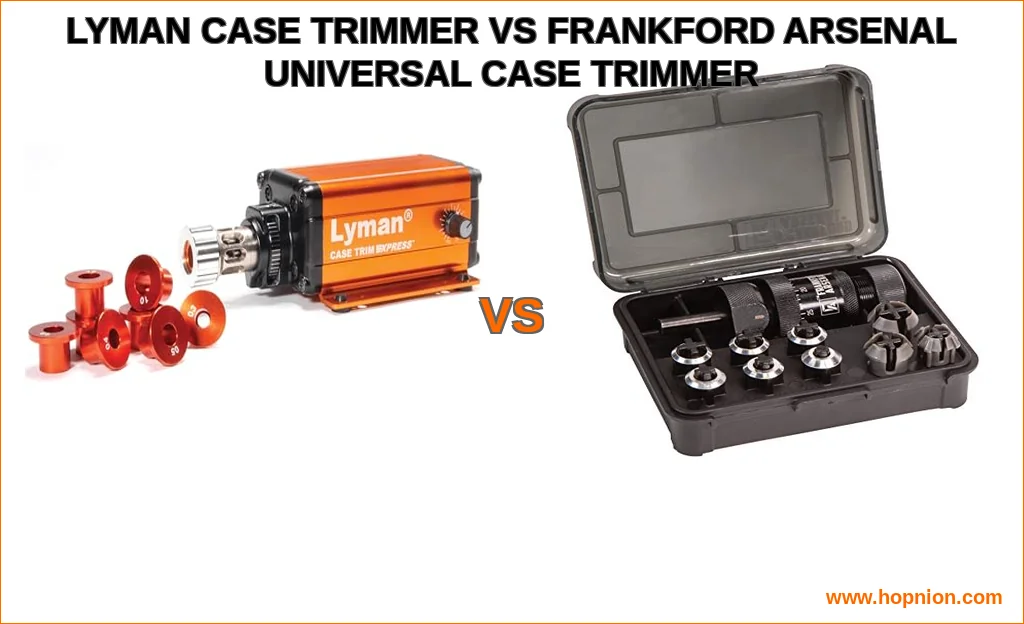
Head-to-Head Feature Breakdown
At their core, both tools aim to trim cases to a precise length. How they achieve that goal, however, is where they diverge dramatically. One is a complete, self-contained system. The other is a versatile accessory for your existing workshop tools. Let’s break down the specs side-by-side.
| Feature | Lyman Brass Smith Case Trim Xpress | Frankford Arsenal Universal Precision Case Trimmer |
|---|---|---|
| Power Source | Integrated variable-speed motor | Requires external 1/2″ drill or drill press |
| Case Holding System | 10 included bushings that contact the case shoulder | Universal Shell Holder System with adjustable collet |
| Adjustment System | Fixed, bushing-based length setting | Built-in depth Micrometer Adjustment |
| Compatibility | Bottleneck rifle cases (via specific bushings) | Shouldered cases from .17 Rem to .460 Weatherby |
| Key Construction | Carbide cutter | Hardened stainless-steel (HSS) cutter |
| Included Storage | Not specified in core features | Strong plastic storage case for collets/collars |
| Check current price on Amazon | Check current price on Amazon |
Precision & Consistency: Micrometer vs. Bushing System
This is the heart of the debate for anyone asking which case trimmer is more accurate for precision rifle. The adjustment mechanism dictates your control over the final case length gauge.
The Frankford Arsenal trimmer features a built-in depth micrometer. This allows for micro-adjustments, letting you dial in the exact trim length you desire. You’re not locked into preset increments. The tool also has a brass shaving ejection port to keep the cutter head area clean, which can contribute to consistent operation. Speaking honestly, this micrometer system is a significant advantage for loaders who tweak lengths for specific rifles or bullet seating depths.
The Lyman system uses a different philosophy. Precision is achieved through its shoulder-contact bushings. Each bushing is machined to set the case at a specific length relative to the carbide cutter. The unit is designed for speed and repeatability: insert the correct bushing, push the case, and get a consistent trim. The trade-off is flexibility. To change trim length, you typically need a different bushing. My honest assessment is that the Lyman excels at high-volume, consistent trimming of a known length, while the Frankford offers finer, on-the-fly tunability.
Setup, Operation & User Experience
Ease of use and setup is where these trimmers feel like they’re from different planets. The universal case trimmer setup time comparison heavily favors one for plug-and-play and the other for ultimate flexibility.
The Lyman Case Trim Xpress is arguably the simpler machine to start using. It has its own power source and motor. You unpack it, plug it in, select the bushing for your caliber, and you’re trimming. There’s no fiddling with a separate drill or worrying about RPM consistency. The variable-speed motor lets you control the cutting action. This integrated approach minimizes vibration and noise compared to using a handheld drill, addressing a key missing entity often overlooked in reviews. For a beginner or someone who values a dedicated reloading bench tool, this is a major point.
The Frankford Arsenal trimmer is a study in versatile design. It requires a 1/2-inch drill or drill press to function. Its genius is the Universal Shell Holder System. One adjustable collet indexes on the case shoulder and is designed to work with a massive range of shouldered cartridges. You don’t need a drawer full of specific shell holders. Setup involves chucking the tool into your drill, adjusting the collet for your case, and setting the micrometer. Honestly speaking, the initial setup might take a moment longer, but the ability to switch calibers without changing physical parts is a huge time-saver for those who load many different rifle rounds.
Ergonomics and the
Most comparisons stop at speed and accuracy. But what about the physical experience? Hand fatigue is real during long reloading sessions.
- Lyman: The push-to-trim action is straightforward. The case is guided by the bushing, and you control the feed pressure. The machine’s base provides stability. The ergonomics are generally good, as the design focuses on a single, repetitive motion.
- Frankford Arsenal: Operation depends heavily on your drill. A heavy, poorly balanced drill can make the process cumbersome. Using a drill press, however, creates an extremely stable and controlled setup, arguably better for ultimate precision. The tool itself is just the trim die and cutter; the feel is dictated by your power tool choice.
From my honest perspective, the Lyman offers a more standardized, ergonomic experience. The Frankford’s ergonomics are a variable you control based on the drill you pair it with. For more stable shooting platforms that start at your bench, check out our guide to the best picatinny bipods.
Durability, Maintenance & Long-Term Value
Both companies tout durable cutters. Lyman uses a long-lasting carbide cutter, while Frankford Arsenal uses an ultra-hard hardened stainless-steel (HSS) cutter said to stay sharp for thousands of rounds. In practical terms, both are built for the long haul with proper use.
Maintenance is generally simple: keep them clean and occasionally lubricate moving parts. The real long-term value discussion revolves around adaptability and cost of expansion.
- Lyman: The system is bushing-based. The trimmer comes with 10 bushings for popular calibers. If you need to trim a cartridge not covered, you must purchase the specific bushing. This adds to the case trimmer maintenance and replacement parts cost over time.
- Frankford Arsenal: The universal collet system means you likely won’t need additional parts to handle new shouldered calibers within its vast range. The included plastic case keeps everything organized. Your investment is largely fixed.
For the reloader who constantly experiments with new or wildcat cartridges, the Frankford’s universal system presents incredible value. For someone who sticks to a stable of 5-10 standard rifle calibers, the Lyman’s included bushings may be all they ever need. I honestly believe this is a critical factor in the price and value equation beyond the initial purchase.
Final Verdict: Who Should Buy Which Trimmer?
So, which one wins? To be completely honest, there isn’t a single winner. There’s a best tool for specific types of reloaders. Your needs dictate the choice.
Choose the Lyman Brass Smith Case Trim Xpress if:
- You want a dedicated, plug-and-play tool for your reloading bench.
- You primarily trim a set list of bottleneck rifle calibers and value speed.
- You dislike the noise and vibration of using a handheld drill for case prep.
- You’re a beginner who wants a straightforward, motorized system to learn on.
Its the streamlined, purpose-built machine. You can read more of our detailed tool analyses to build your ideal setup.
Choose the Frankford Arsenal Universal Precision Case Trimmer if:
- You load a wide variety of rifle calibers and want one tool to handle them all.
- You demand micrometer-adjustable precision for precision reloading.
- You already own a quality drill or drill press and don’t mind using it.
- You want to minimize future accessory costs for new calibers.
- You appreciate the space-saving design of a tool that stores in a compact case.
It’s the versatile, precision-focused workhorse for the experienced or eclectic reloader.
My honest take is that the Lyman Case Trim Xpress is like a premium kitchen applianceexcellent at its specific tasks with minimal fuss. The Frankford Arsenal trimmer is more like a master chef’s knifea versatile, precision tool that becomes an extension of your skill, especially when paired with a drill press. Both are capable of excellent results. Your workflow, caliber diversity, and desire for fine-tuning will point you to the right choice. For unfiltered reviews on gear like this, the team at Honest Opinion is always testing and breaking down what really works at the bench.