
You pick up your rifle. You aim. But what you see through the optic can make or break the shot. Firearm optics are the critical interface between you and your target, transforming a simple firearm into a precision instrument. They’re not just fancy accessories; they’re force multipliers that enhance accuracy, speed, and confidence in every scenario, from home defense to long-range hunting.
Navigating the world of red dot sights, rifle scopes, and everything in between can feel overwhelming. This guide cuts through the noise. We’ll explain the core concepts, break down the different types of optics, and give you the knowledge to choose and use them effectively. For those looking for a robust thermal imaging solution right out of the gate, many experienced shooters start their research with options like the AGM Global Vision series, known for their clarity and durability in demanding conditions.
Types of Firearm Optics: Red Dots, Scopes, Prisms & More
Think of optics in two broad categories: those with magnification and those without. Your intended use dictates which family you belong to.
Non-Magnified Optics: Speed is King
These optics are designed for fast, close-to-medium range target acquisition. Both eyes stay open, giving you a wide field of view and situational awareness.
- Red Dot Sight: The king of speed. It projects a simple LED dot (or other shape) onto a lens. You simply put the dot on the target and fire. Parallax error is minimal, and they work incredibly well for dynamic shooting. Battery life is typically excellent.
- Holographic Sight: Often confused with red dots, but the technology is different. A holographic sight uses a laser to project a reticle pattern onto a holographic film. The main advantage? The reticle stays the same size regardless of viewing angle, and it can be easier for shooters with astigmatism. The debate of red dot vs holographic often comes down to personal preference and budget.
- Prism Scope: A fantastic hybrid. Using a etched glass reticle illuminated by an LED, prism scopes offer a crisp, always-visible aiming point (even without batteries) in a compact package. They have a set, low magnification (like 1x, 3x, or 5x) and are often the answer to “are prism scopes good for astigmatism?“usually, yes, because the etched reticle is a physical object, not a projected smear of light.
Magnified Optics: Precision at Distance
When you need to see and identify your target clearly at longer ranges, magnification is non-negotiable.
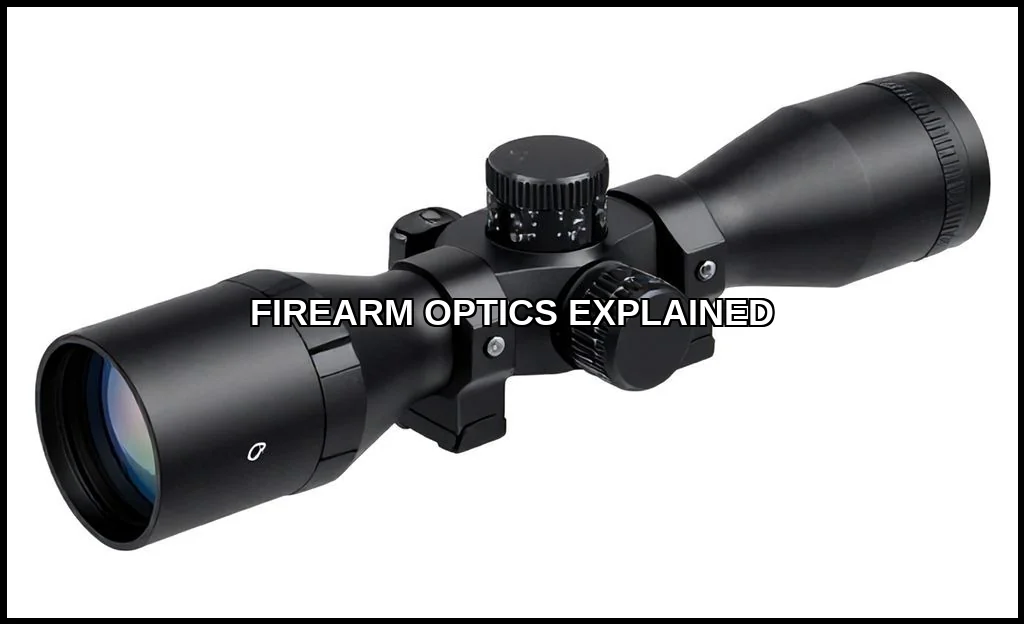
- Rifle Scope: The classic magnified optic. Using a system of lenses, it brings distant targets closer. Variable-power scopes (e.g., 3-9x) offer flexibility, while fixed-power scopes (e.g., 10x) are often simpler and more robust. A proper gun scopes guide will dive deep into tube diameter, objective lens size, and exit pupil.
- LPVO (Low Power Variable Optic): The do-it-all champion for modern rifles. An LPVO, like a 1-6x or 1-8x scope, functions as both a 1x red dot for close quarters and a magnified scope for medium distance. It’s a popular solution for the “what is the best optic for a beginner AR-15” question, offering immense versatility.
Understanding Reticles, MOA, and Magnification
This is where the rubber meets the road. Knowing these terms turns you from a user into an informed operator.
Reticles: More Than Just a Crosshair
The reticle is the aiming pattern in your optic. It can be a simple dot, a duplex crosshair, or a complex grid for bullet drop and windage compensation (a BDC reticle). The design directly impacts how you hold for elevation and wind.
Minute of Angle (MOA): The Language of Precision
Minute of Angle (MOA) is the angular measurement standard in shooting. Simplifying, 1 MOA is roughly 1 inch at 100 yards (2 inches at 200, etc.). When a red dot has a 2 MOA dot, that dot covers 2 inches of target at 100 yards. In a rifle scope, turret adjustments often click in fractions of MOA (e.g., 1/4 MOA per click), allowing for precise zeroing and holdovers.
Scope Magnification Explained: FFP vs. SFP
Scope magnification explained simply: a 4x scope makes a target at 400 yards appear as if it’s 100 yards away. But the reticle’s behavior changes based on its placement.
- First Focal Plane (FFP): The reticle is in front of the magnification lenses. It grows and shrinks with magnification. Holdover marks are accurate at all power settings. Ideal for long-range shooting and tactical use.
- Second Focal Plane (SFP): The reticle is behind the magnification lenses. It stays the same size regardless of magnification. Holdover marks are only accurate at one specific power (usually max). Common on hunting and traditional scopes.
Knowing the difference between first and second focal plane scopes is critical for using your reticle correctly.
The Parallax Problem
Parallax is an optical illusion where the reticle appears to move on the target if your eye isn’t perfectly centered behind the optic. Most red dots and scopes under 10x have it fixed at a certain distance (often 100 yards). Higher-magnification scopes feature a side or objective parallax adjustment knob to eliminate this error for precise shots.
How to Mount, Zero, and Maintain Your Optic
A perfectly chosen optic is useless if it’s not secured and sighted-in properly. This process is non-negotiable.
Mounting: The Foundation
Use a quality mount or base that matches your firearm’s platform. Torque everything to specification using a proper tooldo not guess. Ensure the optic is level. A solid mount is the first step to repeatable accuracy.
Zeroing: Making the Optic Your Own
Zeroing aligns your point of aim with your point of impact at a specific distance. A common and efficient method is learning how to zero a red dot sight at 25 yards. The process is similar for magnified optics:
- Securely bench your firearm.
- Fire a 3-5 round group at the center of your target.
- Measure the center of that group’s distance from your point of aim.
- Adjust your windage (left/right) and elevation (up/down) turrets according to their stated value (e.g., 1/2 MOA per click).
- Fire another group to confirm. Repeat until centered.
Maintenance: Keeping It Clear
Use a lens pen or soft microfiber cloth for cleaning. Never use paper towels or harsh chemicals. Check battery compartments for corrosion periodically. Store optics in a dry, temperate place.
Buyer’s Guide: Choosing the Right Optic for Your Needs
Forget the “best” optic. Focus on the best optic for you. This is the core of any how to choose a rifle optic advice. Ask these questions:
| Your Priority | Recommended Optic Type | Key Features to Look For |
|---|---|---|
| Home Defense / CQB Speed | Red Dot or Holographic Sight | Unlimited eye relief, large window, long battery life, night-vision compatibility. |
| Versatile AR-15 / Patrol Use | LPVO or Prism Scope | 1-x magnification, daylight-bright illumination, durable construction. |
| Big Game Hunting | Traditional Rifle Scope | Moderate variable magnification (3-9x, 4-12x), waterproof/fogproof, simple duplex reticle. |
| Long-Range Precision | High-Magnification FFP Scope | First Focal Plane, high magnification (5-25x+,) exposed tactical turrets, zero-stop, parallax adjustment. |
| Budget-Conscious Beginner | Quality Red Dot or Fixed-Power Prism | Proven reliability over exotic features. This is where a solid optics for beginners philosophy pays off: buy once, cry once. |
Your budget, firearm, and primary use case create a Venn diagram. The overlap is your ideal optic. Start with your core mission. A magnified scope is a liability in a hallway, just as a red dot is limiting on a prairie. Modern optics are marvels of engineering, but they are tools. The right tool, properly mounted and zeroed, transforms your capability. It bridges the gap between intention and impact. Now you have the framework to make an informed choice and shoot with greater confidence.