

When it comes to binocular with night vision, many homeowners face a frustrating gap between expectation and reality. You envision crisp, clear observation of wildlife at dusk, security monitoring of your property’s perimeter, or simply enjoying the night sky. Instead, you’re often met with grainy, dark images, eye strain, and a device that’s too bulky to use spontaneously. The core problem isn’t a lack of desire to see in low light; it’s navigating the technical trade-offs to find a tool that actually works for your life.
Benefits Specific to binocular with night vision
Let’s cut through the marketing. True “night vision” in the military sense requires image intensifier tubes and often comes with a five-figure price tag. For most civilians, “binocular with night vision” really means superior low-light performance. The benefits of achieving this are profoundly practical.
- Extended Observation Windows: Wildlife isn’t on a 9-to-5 schedule. The hour after sunrise and before sunset the so-called ‘golden hours’ for activity are also notoriously dim. Quality optics let you reclaim this time.
- Enhanced Security and Awareness: It’s about verifying what that shape is in the backyard without flipping on a floodlight and startling everything (or everyone). It’s passive observation.
- Preserved Night Vision: Your eyes take up to 30 minutes to fully adapt to darkness. Using a device with bright, clear optics means you’re not constantly ruining your own natural night vision by looking at a glaring, poor-quality image.
- Versatility in Investment: A binocular that performs well at dusk will inherently be sharper and brighter at noon. You’re buying capability for all conditions, not just one.
“I spent years using a clunky pair I inherited, convinced I just had bad ‘night eyes.’ Then I borrowed a pair with proper coatings and prisms during a camping trip. The difference wasn’t incremental; it was like someone had turned on a dimmer switch for the whole forest. And yes, I learned this the hard way by missing a magnificent elk at 50 yards because my gear failed me.”
The Core Challenges You’re Up Against
Understanding the problem is 80% of the solution. Your struggles likely fall into a few key categories.
Light Gathering: The Fundamental Physics
Every binocular is a light pump. Objective lenses gather light, the optical path transmits it, and the eyepieces funnel it to your eyes. Any inefficiency in this chain means a darker image. The biggest culprits? Small objective lenses, poor prism glass, and uncoated optics that reflect instead of transmit light.
The Portability Paradox
There’s a persistent myth: better low-light performance requires massive lenses. While a 50mm objective gathers more light than a 25mm, it also means a heavier, bulkier binocular. If it’s sitting in your closet because it’s a hassle to carry, its performance is zero. The real challenge is balancing light intake with a form factor you’ll actually use.
Image Clarity vs. Magnification
Here’s the contrarian point: Bigger magnification doesn’t mean better night viewing. In fact, it often hurts it. Higher magnification narrows your field of view, amplifies hand shake, and darkens the image. For low-light stability and finding targets, a wider field of view at a moderate magnification (like 8x or 10x) frequently outperforms a shaky, narrow 15x image.
Deconstructing the Technical Specs That Matter
Forget the flashy stickers. Focus on these three specifications. Think of them as the framework for your decision.
| Specification | What It Really Means | Low-Light Impact |
|---|---|---|
| Prism Type (BAK4 vs. BK7) | The glass used in the prisms that correct the image orientation. | BAK4 glass has a higher refractive index, producing a round, fully illuminated exit pupil with no visible edges (vignetting). This means a brighter, more uniform image, critical in dim conditions. |
| Optical Coatings (Fully Multi-Coated) | Microscopic layers on lens surfaces that reduce light reflection. | Each air-to-glass surface can reflect 4-5% of incoming light. In a binocular with 10+ surfaces, that’s catastrophic. Multi-coating on all surfaces ensures maximum light transmission often over 90% which is non-negotiable for night vision performance. |
| Exit Pupil Diameter | Calculation: Objective Lens Diameter / Magnification. The cylinder of light that reaches your eye. | Your eye’s pupil dilates to about 5-7mm in darkness. An exit pupil larger than this (e.g., 5mm from a 10×50 configuration) provides a bright, easy-to-align image. A tiny exit pupil (like 2mm from a 12×25) demands perfect alignment but can be very bright if the optics are high quality. |
Here’s what I mean: A binocular with BAK4 prisms and fully multi-coated optics but a 12×25 configuration can outperform a larger, cheaper binocular with BK7 prisms and coated lenses. The quality of the light path trumps raw size.
A Solution in Practice: Bridging the Gap
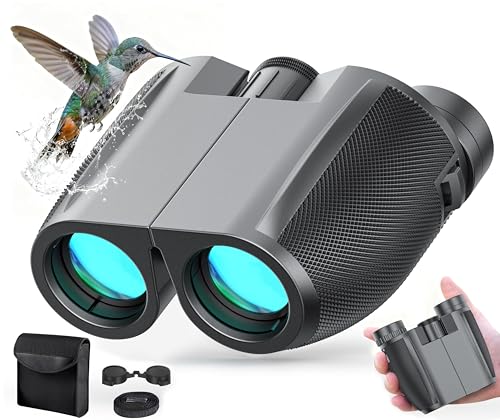
Let’s apply this framework to a real-world example. Take a product like the “Gifts for Men Binoculars 12×25 for Adults and Kids.” On paper, a 25mm objective lens suggests a compromise for low light. But the listed features BAK4 prisms and fully multi-coated optics are direct answers to the light-gathering challenge. They’re engineering around the size limitation.
- Problem Solved: Immediate Readiness. Its compact, 0.7lb form factor means it can live in a daypack or glove box. The best binocular is the one you have with you when the owl lands on the fencepost at twilight.
- Problem Solved: Versatile User Fit. Twist-up eyecups accommodate glasses, ensuring everyone gets the full field of view and light exit pupil. No light leak from improper eye relief.
- Inherent Trade-off Acknowledged: The 12x magnification paired with a 25mm lens creates a smaller exit pupil (~2.1mm). This requires a steadier hand and more precise eye placement. For prolonged night sky viewing, it’s not ideal. For quick, targeted observations of birds at dusk or a stage during an evening concert, it’s a viable, portable solution.
The result? A tool that fits a specific niche: the user who prioritizes portability and needs competent low-light performance for short-to-medium duration viewing, not midnight surveillance. it’s a reminder that “binocular with night vision” is a spectrum, not an absolute.
Your Action Plan for Better Low-Light Viewing
Stop browsing randomly. Use this methodical approach.
- Define Your Primary Scenario: Is it backpacking (weight critical), backyard birding (some bulk okay), or security (tripod use possible)? This dictates size.
- Prioritize Optics Over Magnification: Insist on BAK4 prisms and Fully Multi-Coated lenses as your baseline. This is the non-negotiable foundation for light transmission.
- Calculate the Exit Pupil: For general low-light use, aim for an exit pupil of 4mm or larger. (E.g., 8×32 = 4mm, 10×50 = 5mm). For compact models, understand you’ll trade some ease of use for portability.
- Handle Before You Buy: Adjust the focus and diopter. Are the controls smooth? Does the image snap into sharpness easily? Eyestrain kills night observation.
- Test in Low Light: If possible, evaluate a model in a store’s darker corner. Look for contrast and clarity, not just brightness.
An unexpected analogy: Choosing a binocular for low light is like soundproofing a room. You can have a huge window (big objective lens), but if the seals are poor (bad coatings) and the glass is thin (cheap prisms), noise (light) still escapes. A smaller, well-sealed window with thick, laminated glass (high-quality compact optics) often creates a better controlled environment.
Your goal isn’t to find a magical device that turns night into day. It’s to select an optical tool that efficiently harnesses every available photon to deliver a bright, sharp, and usable image for your specific needs. Start with the problem, apply the framework, and let the specs tell you the truth. Happy observing.
🌟 Order Now – Feel the Improvement
👉 Check the Latest Price on Amazon 👈
⭐️ Trusted by 1,000+ Customers Worldwide